









Optical Profilometry Unlimited - Keyence VK-X3050 3D Surface Profiler
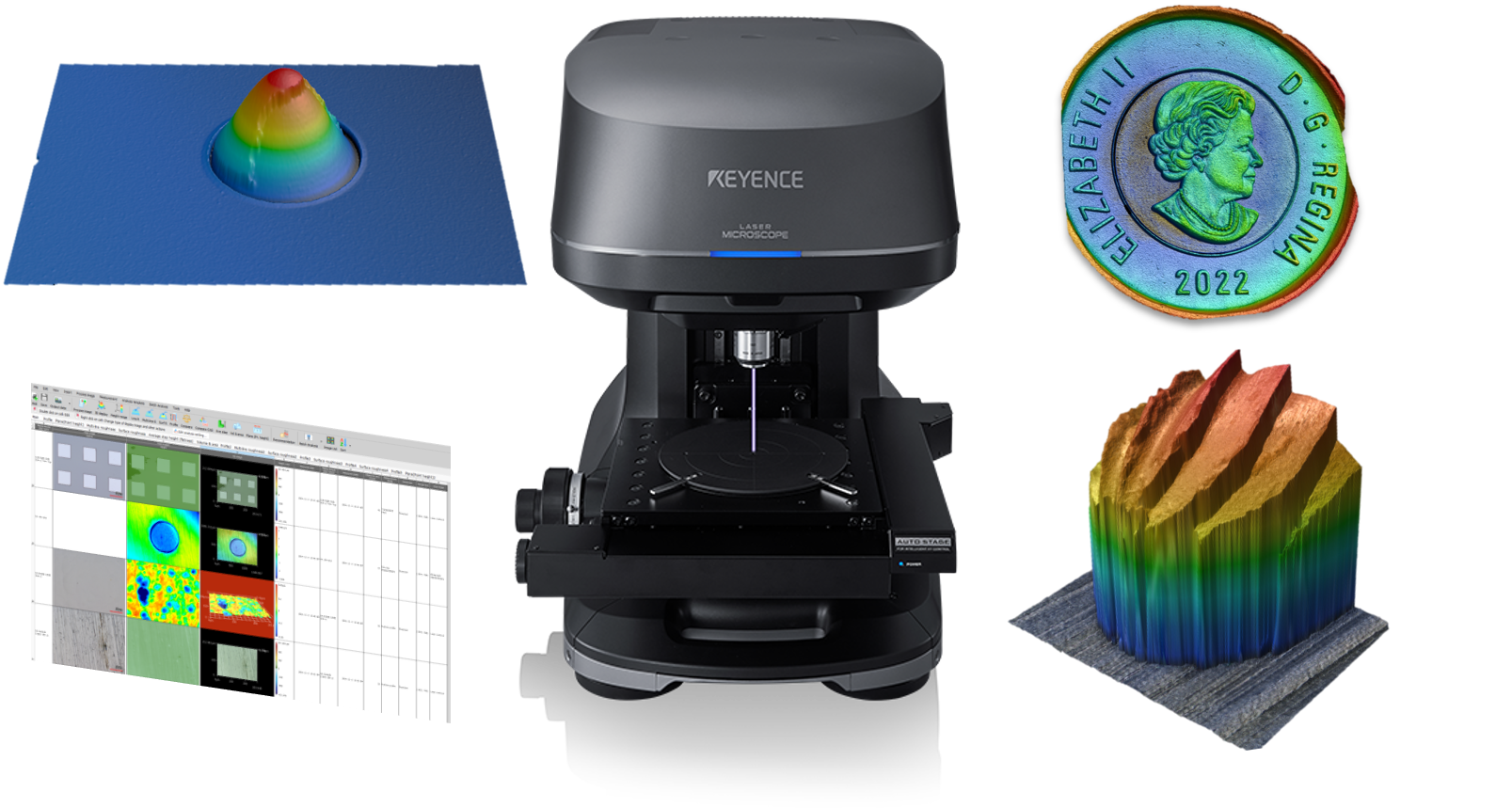
The nanoFAB is pleased to announce the installation of a multi-mode Optical Profilometer from Keyence. The Keyence VK-X3050 is a red laser scanning confocal system equipped with confocal, white light interferometry (WLI), and focus variation metrology modes. The tool natively offers wide-area scanning through stitching modes. Feature-aligned, repetitive, and correlative multi-objective multi-mode measurements are enabled through user-defined Teaching modes.
Feature list:
- 661nm Confocal (5x, 10x, 20x, 50x, 100x 150x)
- Focus Variation (5x, 10x, 20x, 50x, 100x 150x)
- Ring light and Coaxial modes are supported
- White light Interferometry (10x, 20x, 50x)
- Large area stitching
- Automated measurement modes (Teaching)
- Offline Analysis: Multi-file analyzer (CME L2-112 TENK01)
- 100x100mm automated stage supporting up to 4" Wafers'
- Through film laser thickness measurements (>1um)
Resolution:
The three analysis modes support a scaled level of resolution and accuracy. Users can combine any of the three modes to support analysis needs down to 1nm Z-resolution in Confocal and Focus Variation modes, and 0.01nm Z-resolution in WLI mode.
Laser Scanning Profilometry
The system is equipped with a high-resolution 16-bit photomultiplier that enables deep feature extraction of hard-to-analyze features such as 1µm Silicon vias. The system has demonstrated 30µm of depth resolution in narrow/confined grooves in some applications. Leveraging the high-resolution measurement capability, the automated XY stage (100mm x 100mm) allows for larger-scale analysis using single or multiple objectives. The automated measurement allows for stitching of large area samples with spatially separate or continuous features. Beyond the profilometry capabilities, optical observation can be supported, coupled, and enhanced by the laser observation modes, enabling transparent feature on transparent substrate imaging.
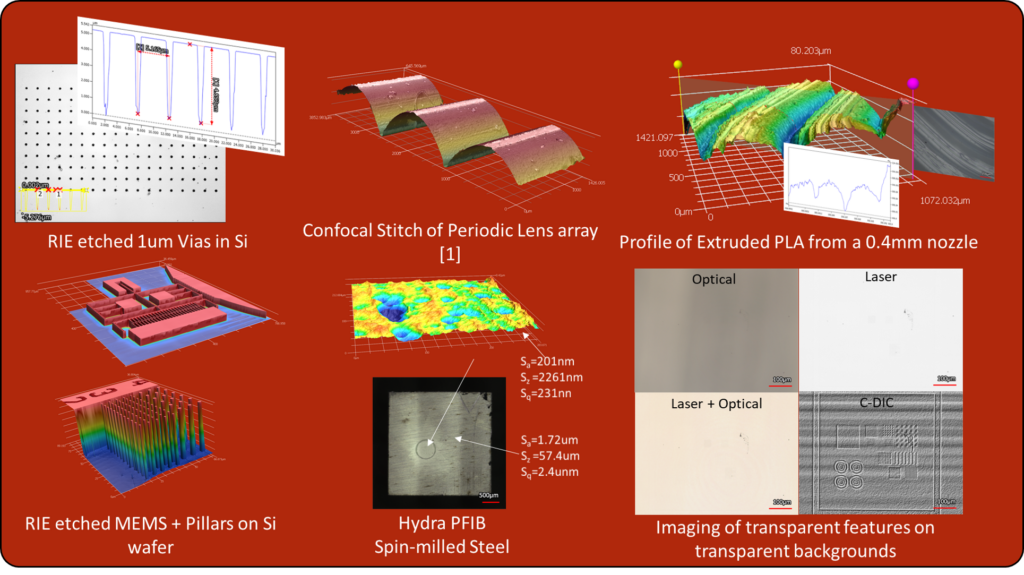
[1] Lens array provided by Avalon Holographics as part of their 3D holographic display system
White Light Interferometry and Analysis software
In cases where Confocal microscopy fails to resolve features, the WLI mode acts not only as a complement but also as an enhancement. The WLI mode allows users to level samples through intelligent tip-tilt alignment with guided steps to achieve high-resolution measurements. The resulting files can be analyzed in the same browser as the laser confocal modes and are easily tracked by utilizing the built-in measurement metadata.
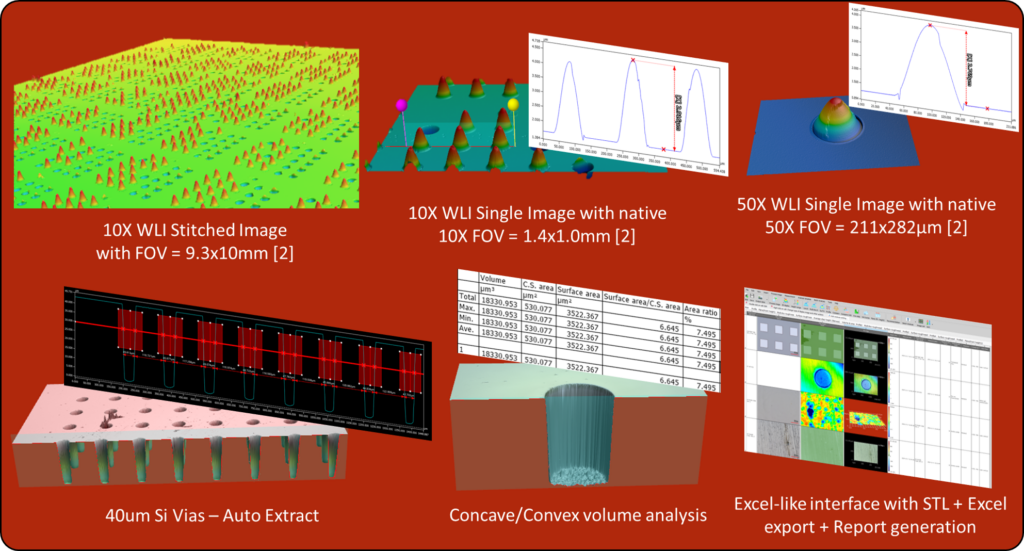
[2] Optomechanical sensors arrays are provided by Kyle Scheuer from Ultracoustics Technologies LTD
Focus variation profilometry and Teaching Modes
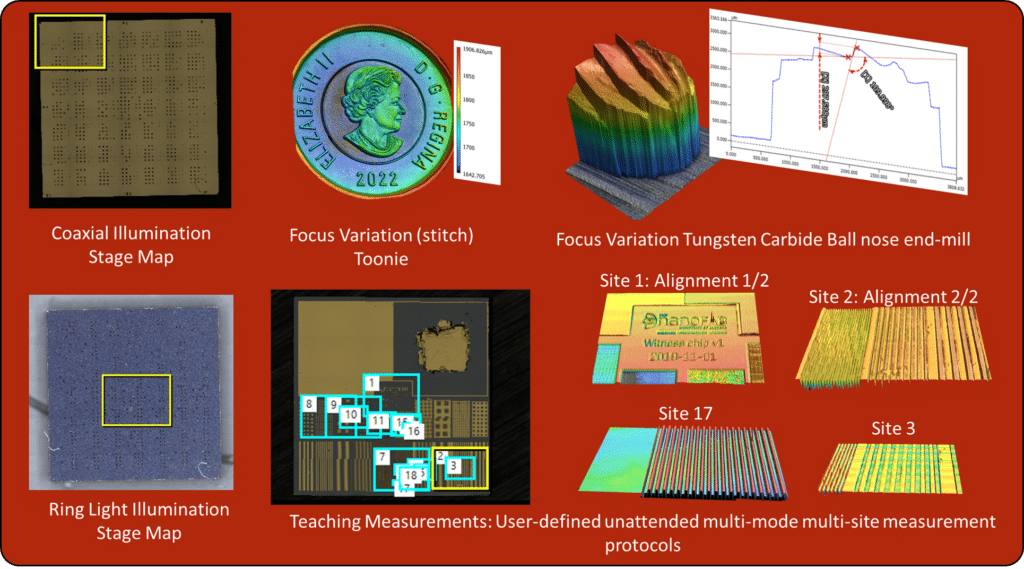
The system features a built-in sample mapping mode that supports any objective and allows mapping in laser and optical observation modes. Defect inspection is achievable through this feature mapping by ring-light illumination, allowing for highlighting of defect locations. The Coaxial/Ring light modes are supported by a Focus Variation Profilometry technique, enabling fast measurement of millimeter-scale features of bulk metals, coins, and machined parts. Any of the three modes, techniques, or setups can be further enhanced by the Teaching Measurement mode. Teaching Measurement modes allow for multi-mode, multi-objective, multi-site analysis that can be feature aligned across multiple runs or iterations performed today, or tomorrow.