



Back to News
fabrication  |  featured  |  news

Multilevel deep etching in silicon
Aaron Hryciw
2021-10-08
Fabricate designs with multilevel deep etched structures via DRIE
Multilevel DRIE features
fabrication | featured | news

Deep reactive ion etching (DRIE) of Si is a core process in MEMS and other Si micromachining applications. The cyclic Bosch etch process enables deep (tens to hundreds of µm), high-aspect-ratio features to be etched in Si, with vertical sidewalls, fast etch rates (>10 µm/min), and high selectivity to both photoresist (~100:1) and oxide (~300:1).

However, when fabricating multilevel designs—wafers which have two or more different etch depths, differing by some tens of µm—the deep features enabled by DRIE can pose a challenge. A common application requiring multilevel designs is microfluidics, where PDMS is cast and cured in a mould fabricated from a Si wafer: multiple etch depths are needed to produce channels with different flow characteristics, or to introduce constrictions between channels.
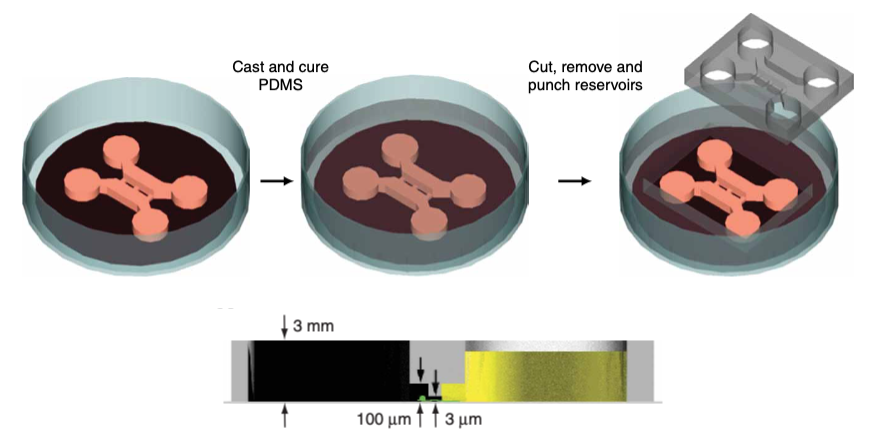
Example of multilevel PDMS microfluidics device.

Example of multilevel PDMS microfluidics device.[Ref 1Ref 2]

Although <1 µm of photoresist thickness is required to mask a 20 µm deep etch, spin-coating such thin photoresist over a 20 µm feature can yield poor resist uniformity. Depending on the lateral feature sizes in the design, there can also be challenges in exposing resist at the bottom of a trench (e.g., proximity exposure in a mask aligner, depth of focus in a direct-write system). These effects combined can frustrate efforts to faithfully reproduce the desired design features on the wafer—a problem which is only exacerbated as the number of levels increases.

One method to overcome these challenges is to take advantage of the large selectivity afforded by a thermal oxide mask when Bosch etching: by building up a multilevel hard mask in the SiO2 prior to performing any DRIE, the maximum topography variation is that of the oxide thickness only, such that conventional spin-coating of thin photoresist and exposure can proceed without difficulty. To illustrate this process, we used a design consisting of five pillar heights and three trench depths, to be etched in a Si wafer:
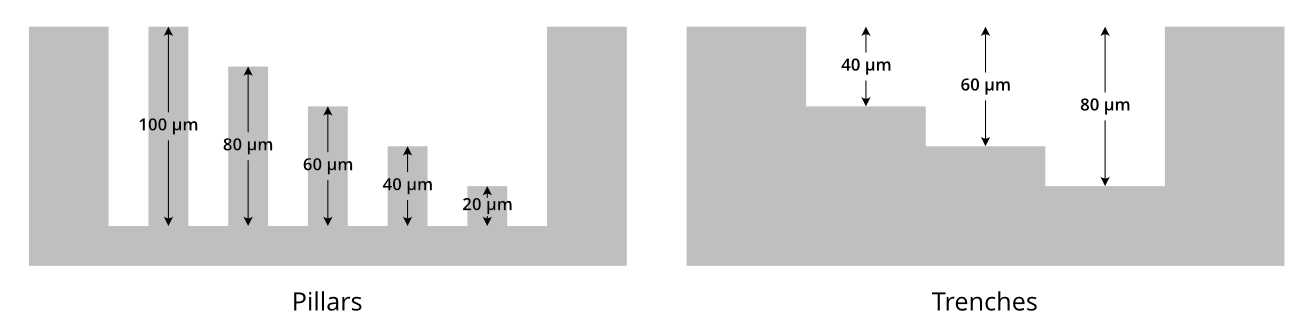
Multilevel DRIE cross-sectional diagram: pillars and trenches
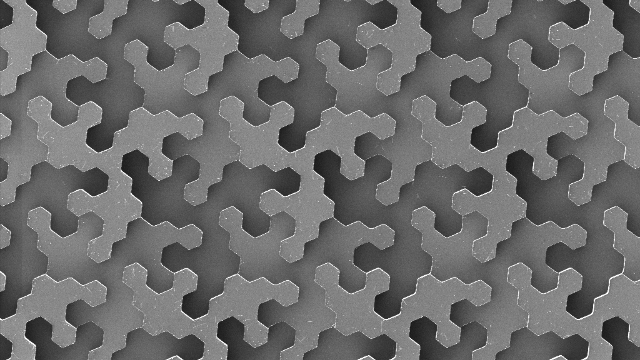
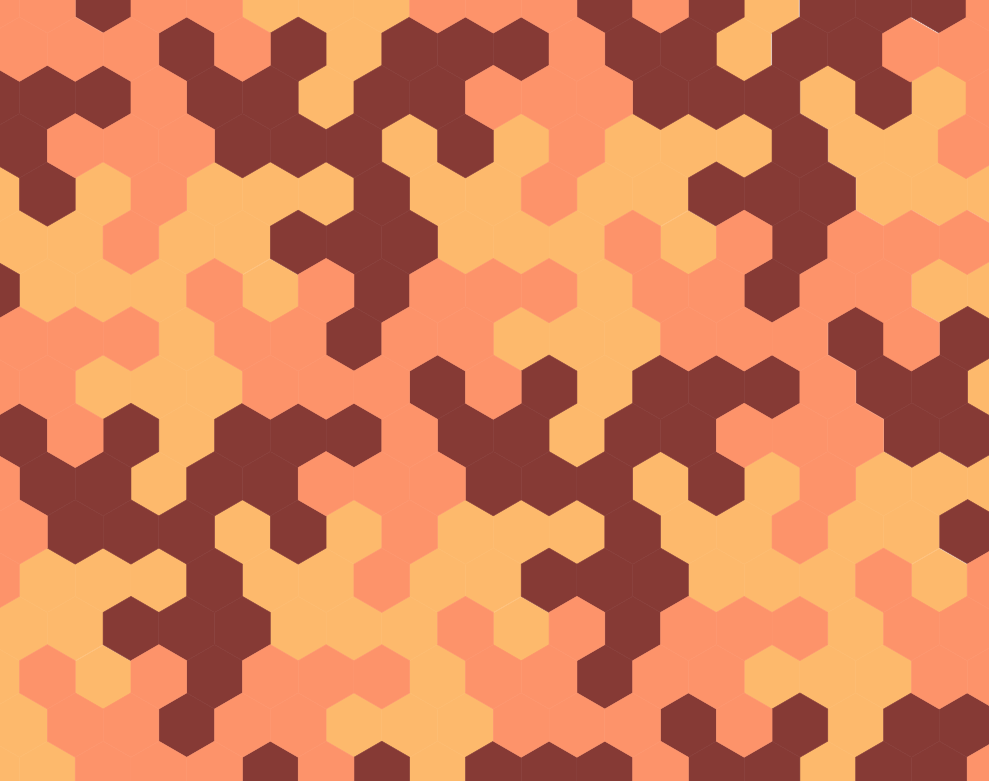
Escheresque tessellation of unit cells with 3-fold rotation symmetry

The lateral design consists of an Escheresque tessellation of unit cells with 3-fold rotation symmetry, purely for visual appeal.

Process flow

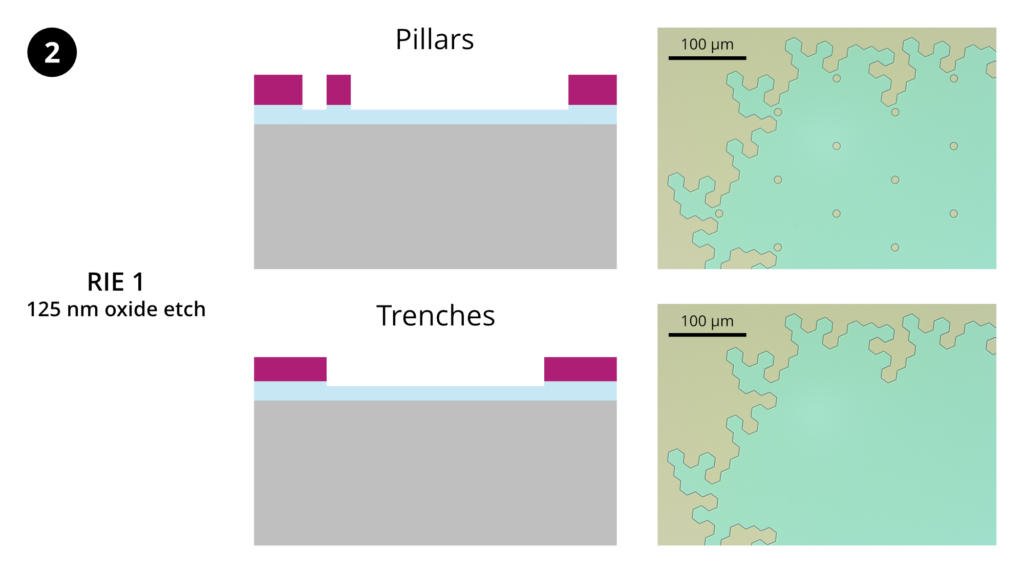
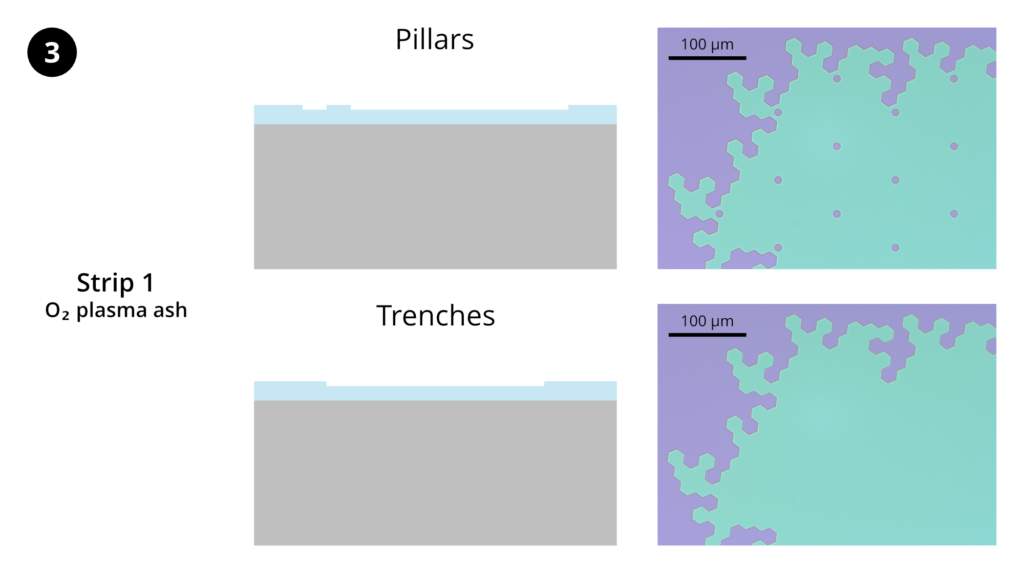
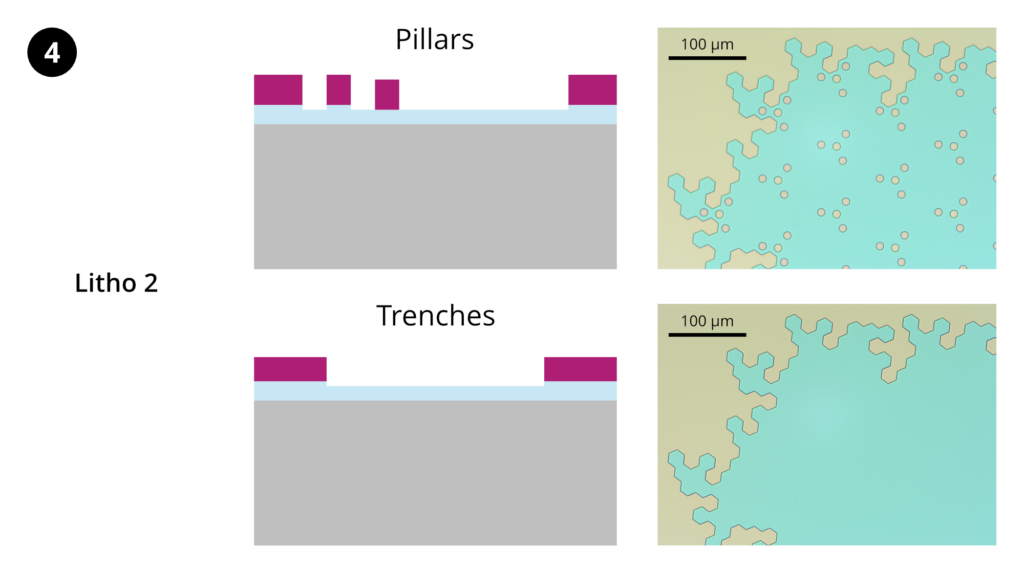
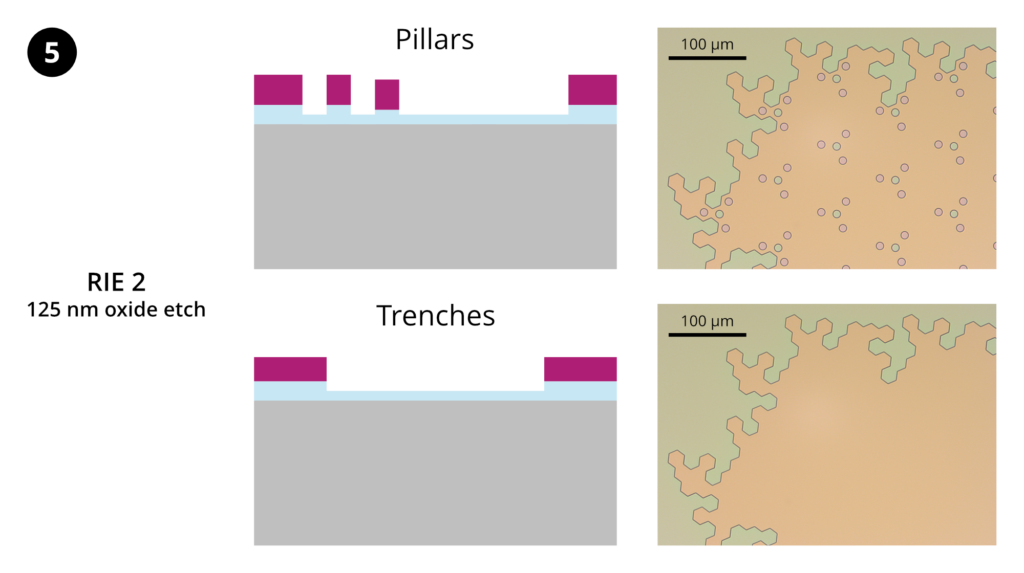
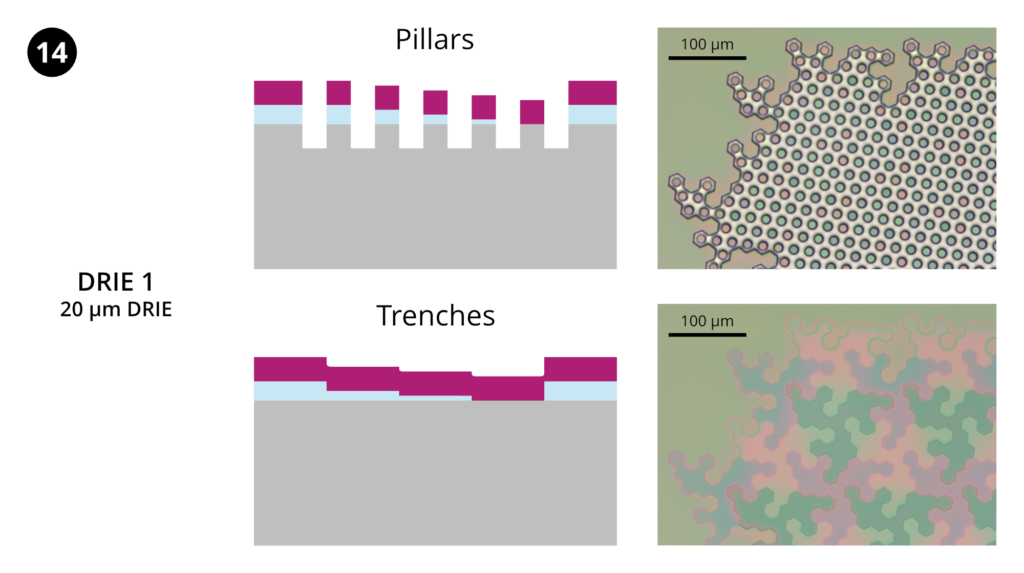
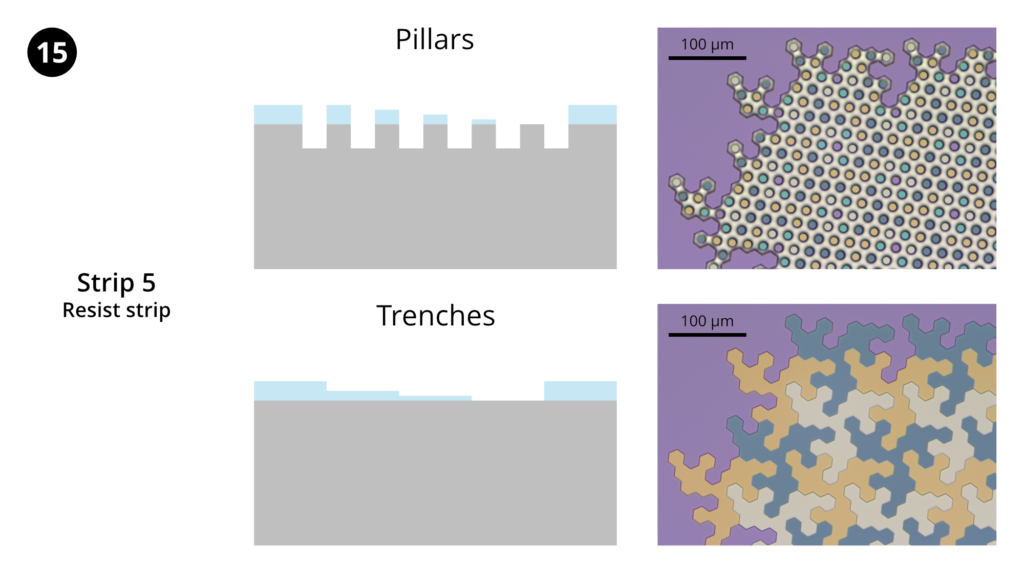
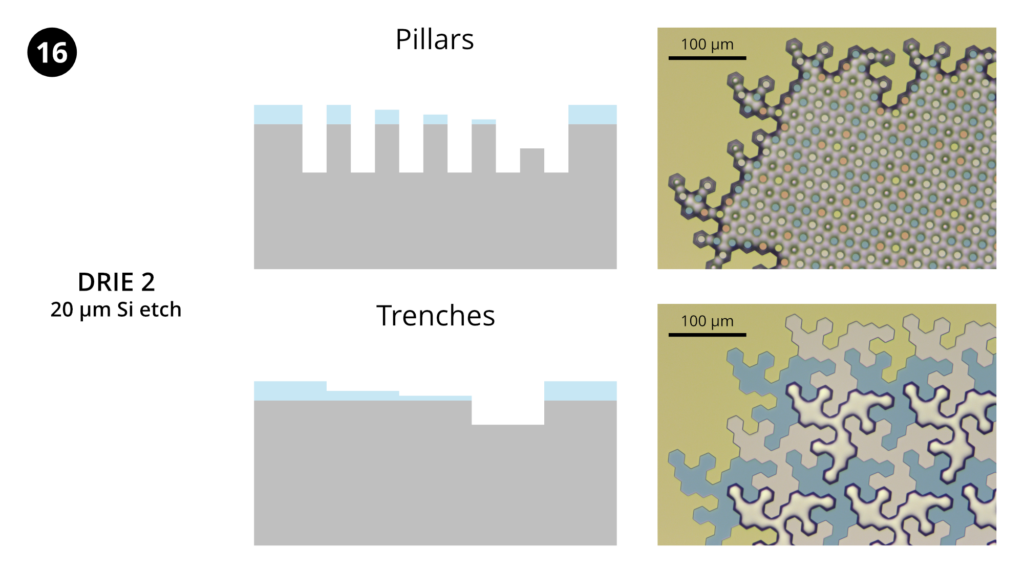
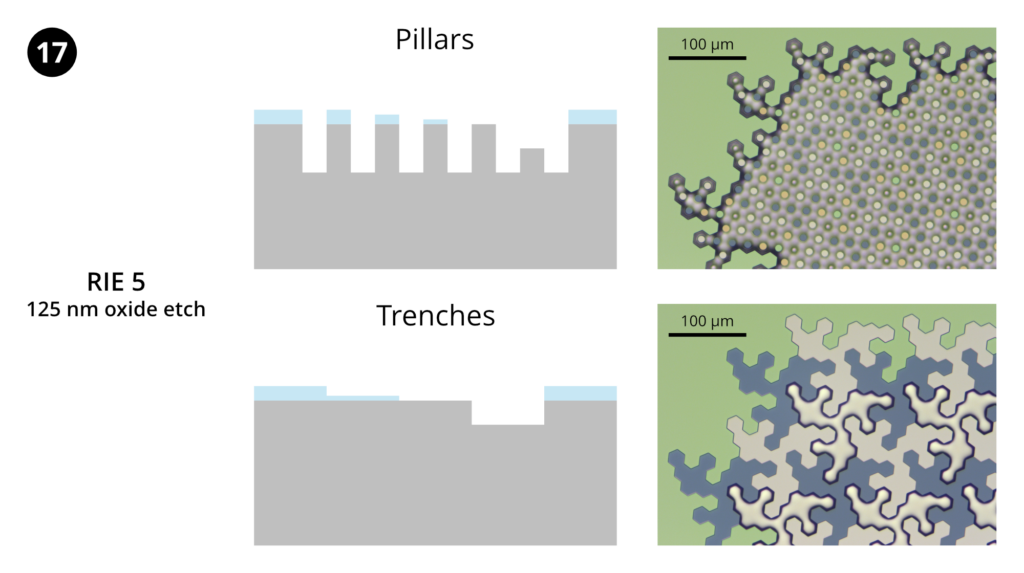
In the following process flow, the substrate is a standard 525 µm thick, 100 mm diameter Si prime wafer with ~500 nm of thermal oxide; ~1.1 µm of AZ 1512 was used for the photoresist, and exposures were done using the Heidelberg MLA150 direct-write laser lithography (maskless aligner) system. The resist strip and oxide etch steps were performed on the Trion RIE, and the DRIE steps were done using the “Bosch smooth sidewall” etch on the Oxford Estrelas ICPRIE. Cross-sectional diagrams (not to scale) of the pillar and trench structures are shown on the left; the right column shows optical microscopy images after performing the given process step.

Step 1: Lithography 1
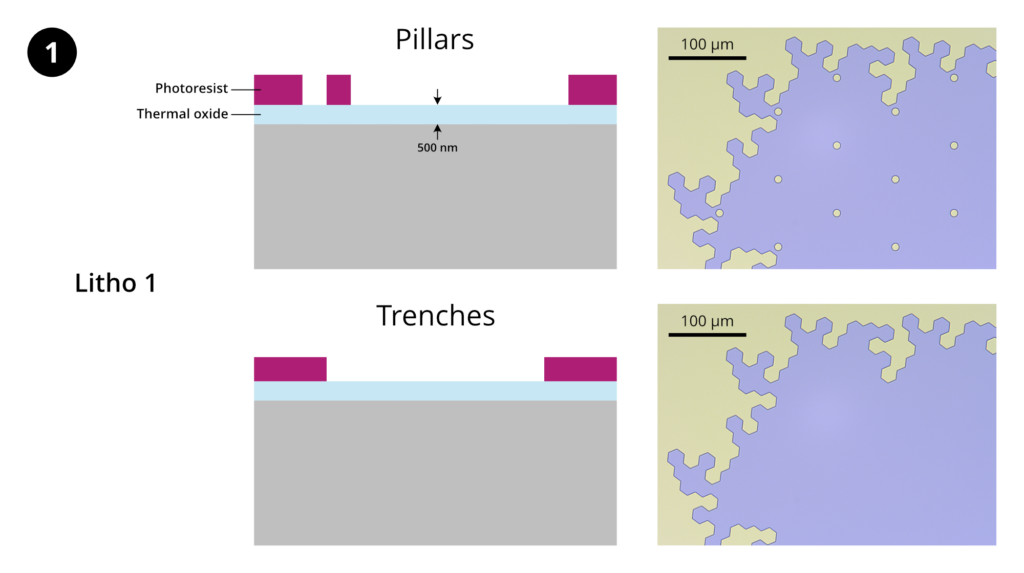
Step 1: Lithography 1. Substrate: 100 mm diameter, 525 µm thick Si prime wafer with ~500 nm thermal oxide. Piranha clean, HMDS prime, spin-coat ~1.1 µm AZ 1512 photoresist, softbake. Expose layer 1 using MLA150 (405 nm). Develop in AZ 400K 1:4.
Substrate: 100 mm diameter, 525 µm thick Si prime wafer with ~500 nm thermal oxide. Piranha clean, HMDS prime, spin-coat ~1.1 µm AZ 1512 photoresist, softbake. Expose layer 1 using MLA150 (405 nm). Develop in AZ 400K 1:4.

Step 2: Reactive ion etching 1

Step 2: Reactive ion etching 1. Etch a quarter of the way through the SiO₂ hard mask (125 nm) using the "oxide" etch on the Trion RIE. Open areas here will result in the deepest features in the final structure.
Etch a quarter of the way through the SiO₂ hard mask (125 nm) using the oxide etch on the Trion RIE. Open areas here will result in the deepest features in the final structure.

Step 3: Resist strip 1

Step 3: Resist strip 1. Strip remaining photoresist using the "O2-stripping" recipe on the Trion RIE.
Strip remaining photoresist using the O2-stripping recipe on the Trion RIE.

Step 4: Lithography 2

Step 4: Lithography 2. HMDS prime, spin-coat ~1.1 µm AZ 1512 photoresist, softbake. Expose layer 2 using MLA150 (405 nm). Develop in AZ 400K 1:4.
HMDS prime, spin-coat ~1.1 µm AZ 1512 photoresist, softbake. Expose layer 2 using MLA150 (405 nm). Develop in AZ 400K 1:4.

Step 5: Reactive ion etching 2

Step 5: Reactive ion etching 2. Etch 125 nm SiO₂ using the "oxide" etch on the Trion RIE.
Etch 125 nm SiO₂ using the oxide etch on the Trion RIE.

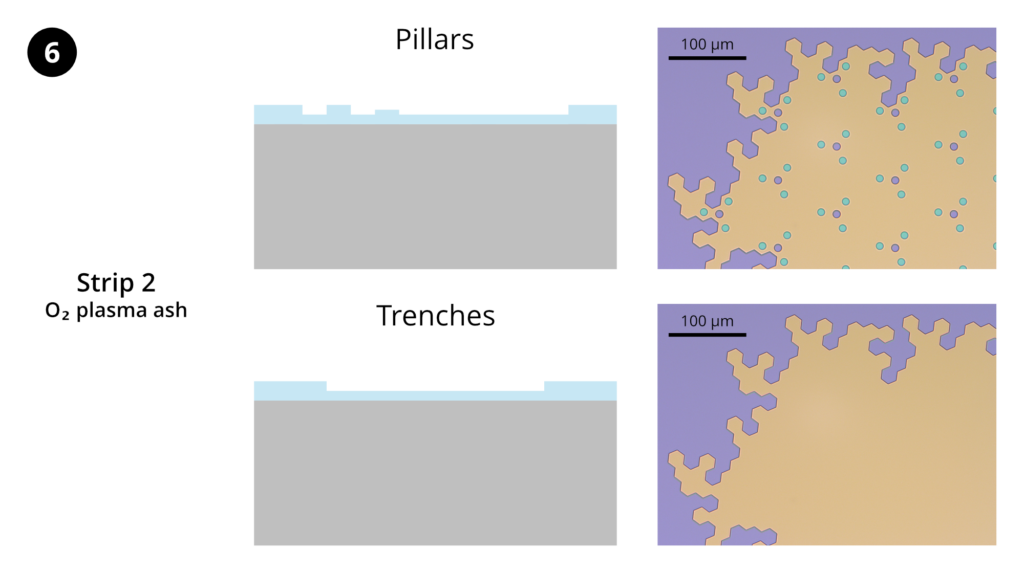
Step 6: Resist strip 2

Step 6: Resist strip 2. Strip remaining photoresist using the "O2-stripping" recipe on the Trion RIE.
Strip remaining photoresist using the O2-stripping recipe on the Trion RIE.

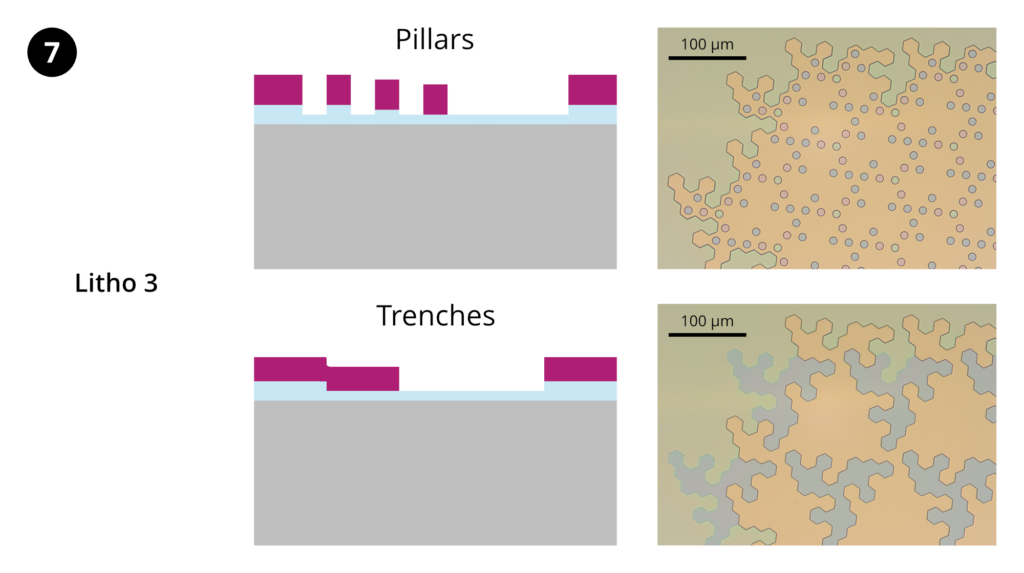
Step 7: Lithography 3

Step 7: Lithography 3. HMDS prime, spin-coat ~1.1 µm AZ 1512 photoresist, softbake. Expose layer 3 using MLA150 (405 nm). Develop in AZ 400K 1:4.
HMDS prime, spin-coat ~1.1 µm AZ 1512 photoresist, softbake. Expose layer 3 using MLA150 (405 nm). Develop in AZ 400K 1:4.

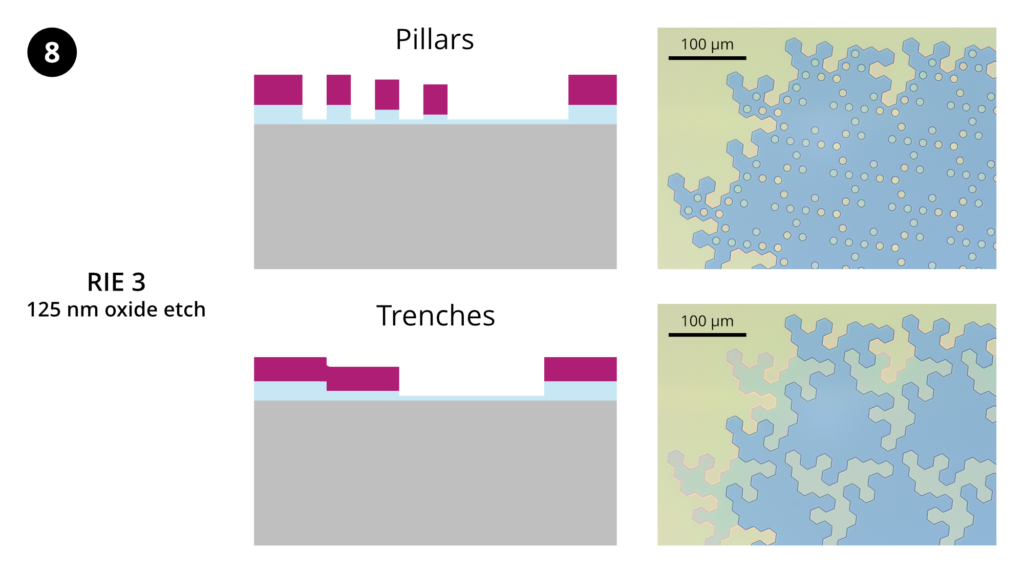
Step 8: Reactive ion etching 3

Step 8: Reactive ion etching 3. Etch 125 nm SiO₂ using the "oxide" etch on the Trion RIE.
Etch 125 nm SiO₂ using the oxide etch on the Trion RIE.

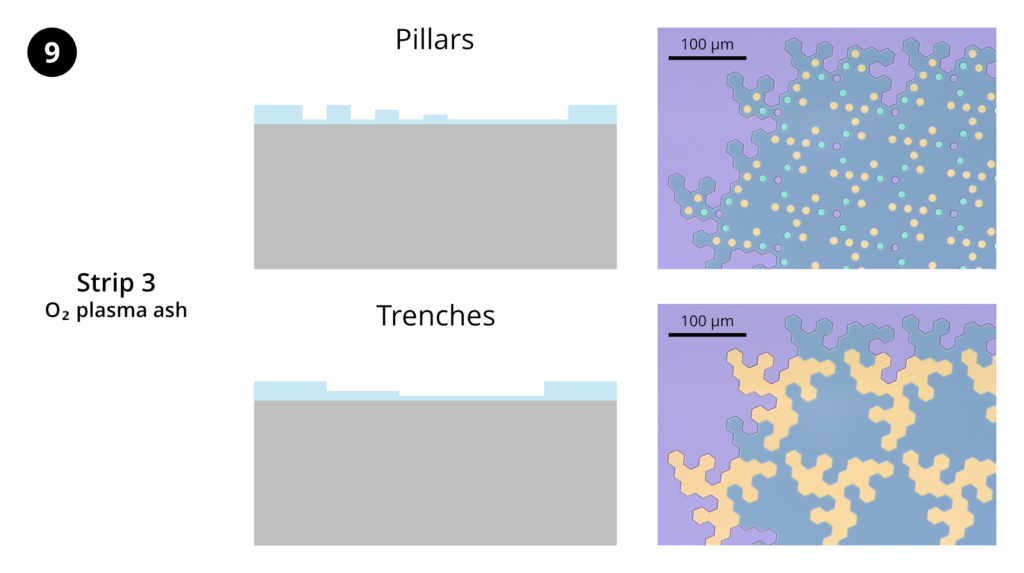
Step 9: Resist strip 3

Step 9: Resist strip 3. Strip remaining photoresist using the "O2-stripping" recipe on the Trion RIE.
Strip remaining photoresist using the O2-stripping recipe on the Trion RIE.

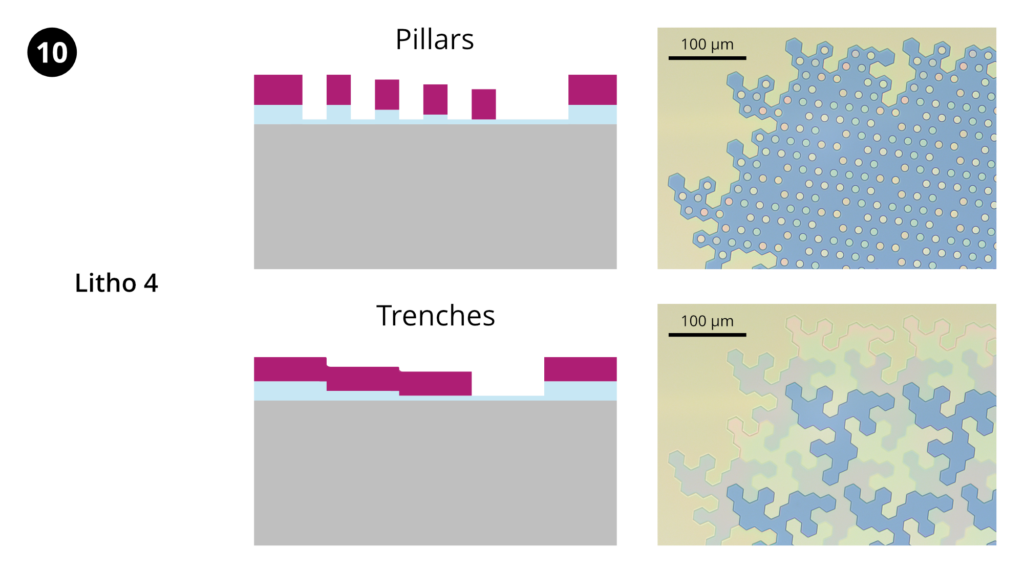
Step 10: Lithography 4

Step 10: Lithography 4. HMDS prime, spin-coat ~1.1 µm AZ 1512 photoresist, softbake. Expose layer 4 using MLA150 (405 nm). Develop in AZ 400K 1:4.
HMDS prime, spin-coat ~1.1 µm AZ 1512 photoresist, softbake. Expose layer 4 using MLA150 (405 nm). Develop in AZ 400K 1:4.

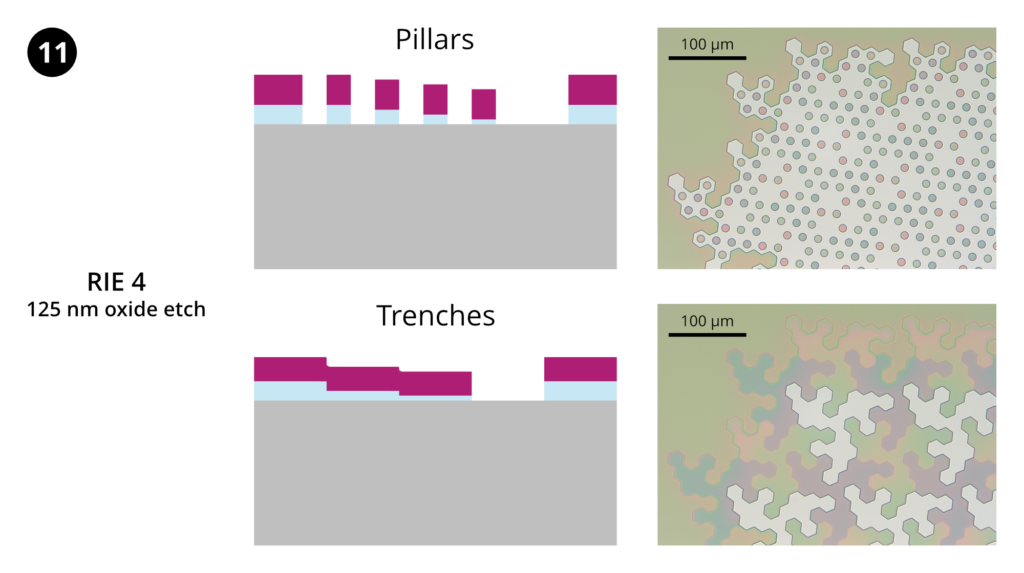
Step 11: Reactive ion etching 4

Step 11: Reactive ion etching 4. Etch 125 nm SiO₂ using the "oxide" etch on the Trion RIE. This is the final step to set up the multilevel hard mask in the oxide.
Etch 125 nm SiO₂ using the oxide etch on the Trion RIE. This is the final step to set up the multilevel hard mask in the oxide.

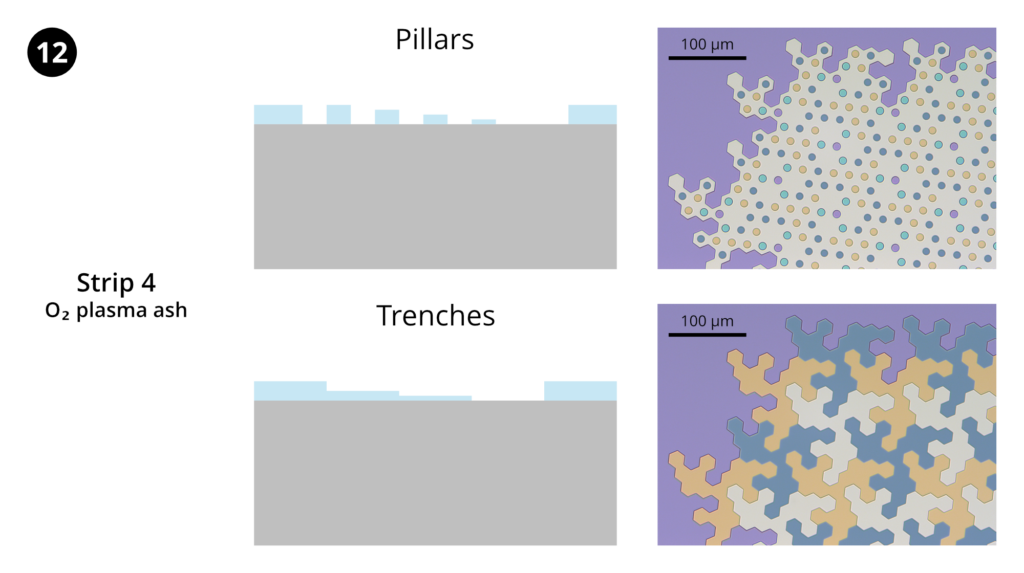
Step 12: Resist strip 4

Step 12: Resist strip 4. Strip remaining photoresist using the "O2-stripping" recipe on the Trion RIE.
Strip remaining photoresist using the O2-stripping recipe on the Trion RIE.

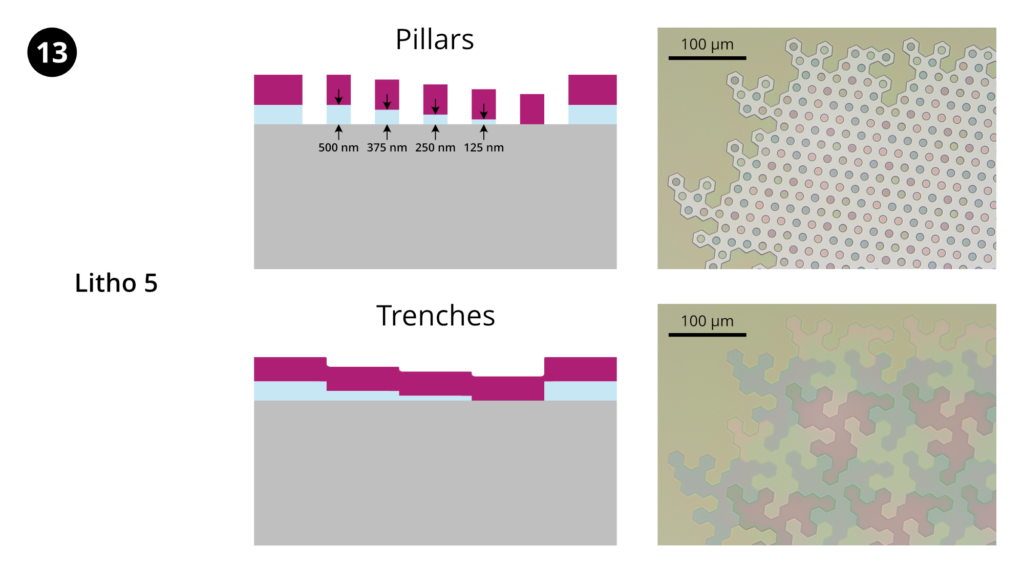
Step 13: Lithography 5

Step 13: Lithography 5. HMDS prime, spin-coat ~1.1 µm AZ 1512 photoresist, softbake. Expose layer 5 using MLA150 (405 nm). Develop in AZ 400K 1:4. Photoresist is used as the mask for the first DRIE step, rather than creating a fifth level of hard mask in the oxide.
HMDS prime, spin-coat ~1.1 µm AZ 1512 photoresist, softbake. Expose layer 5 using MLA150 (405 nm). Develop in AZ 400K 1:4. Photoresist is used as the mask for the first DRIE step, rather than creating a fifth level of hard mask in the oxide.

Step 14: Deep Si etch 1

Step 14: Deep Si etch 1. Etch 20 µm into Si using the "Bosch smooth sidewalls" recipe. This is the only step using photoresist as the mask for DRIE. Note that the trench features are not etched during this step.
Etch 20 µm into Si using the Bosch smooth sidewalls recipe. This is the only step using photoresist as the mask for DRIE. Note that the trench features are not etched during this step.

Step 15: Resist strip 5

Step 15: Resist strip 5. Strip remaining photoresist using the "O2-stripping" recipe on the Trion RIE, revealing the multilevel oxide hard mask. Going forward, the deepest trench and shortest pillar will be etched, as evidenced by the grey colour (bare Si) for these features.
Strip remaining photoresist using the O2-stripping recipe on the Trion RIE, revealing the multilevel oxide hard mask. Going forward, the deepest trench and shortest pillar will be etched, as evidenced by the grey colour (bare Si) for these features.

Step 16: Deep Si etch 2

Step 16: Deep Si etch 2. Etch 20 µm into Si using the "Bosch smooth sidewalls" recipe.
Etch 20 µm into Si using the Bosch smooth sidewalls recipe.

Step 17: Reactive ion etching 5

Step 17: Reactive ion etching 5. Etch 125 nm SiO₂ using the "oxide" etch on the Trion RIE. Going forward, the two deepest trenches and two shortest pillars will be etched.
Etch 125 nm SiO₂ using the oxide etch on the Trion RIE. Going forward, the two deepest trenches and two shortest pillars will be etched.

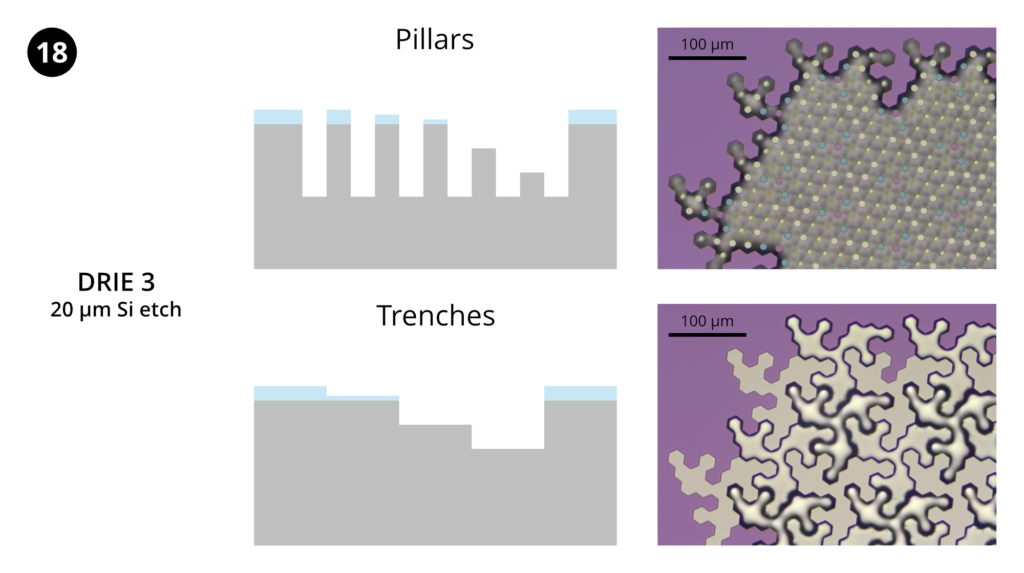
Step 18: Deep Si etch 3

Step 18: Deep Si etch 3. Etch 20 µm into Si using the "Bosch smooth sidewalls" recipe.
Etch 20 µm into Si using the Bosch smooth sidewalls recipe.

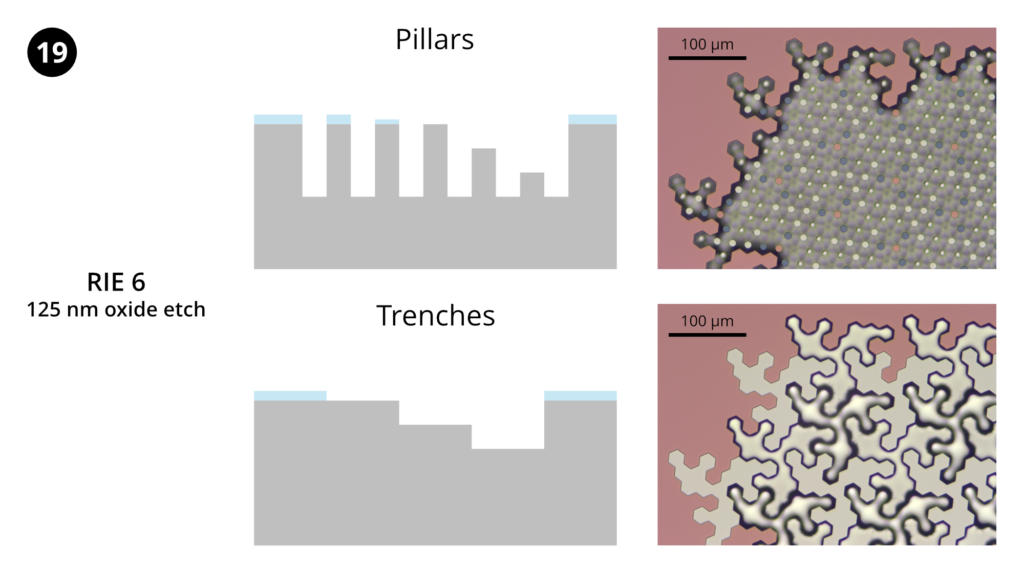
Step 19: Reactive ion etching 6

Step 19: Reactive ion etching 6. Etch 125 nm SiO₂ using the "oxide" etch on the Trion RIE. Going forward, the all trenches and the three shortest pillars will be etched.
Etch 125 nm SiO₂ using the oxide etch on the Trion RIE. Going forward, the all trenches and the three shortest pillars will be etched.

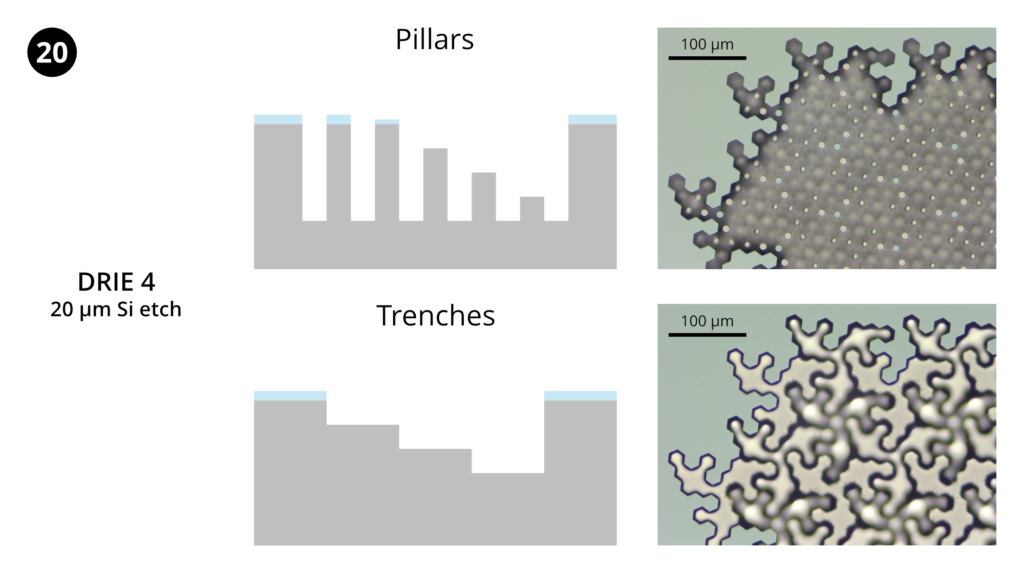
Step 20: Deep Si etch 4

Step 20: Deep Si etch 4. Etch 20 µm into Si using the "Bosch smooth sidewalls" recipe.
Etch 20 µm into Si using the Bosch smooth sidewalls recipe.

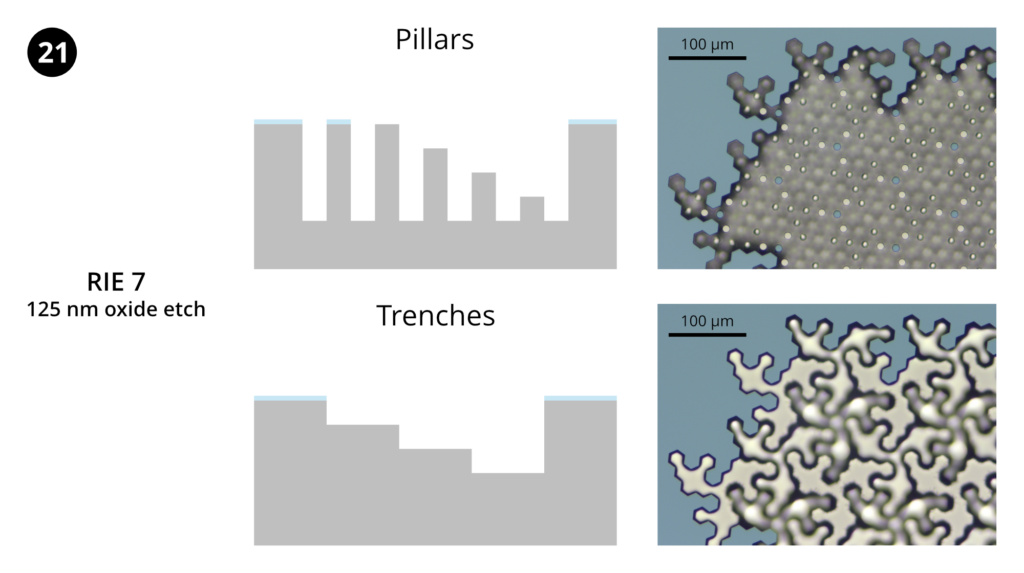
Step 21: Reactive ion etching 7

Step 21: Reactive ion etching 7. Etch 125 nm SiO₂ using the "oxide" etch on the Trion RIE. Going forward, the all trenches and the four shortest pillars will be etched.
Etch 125 nm SiO₂ using the oxide etch on the Trion RIE. Going forward, the all trenches and the four shortest pillars will be etched.

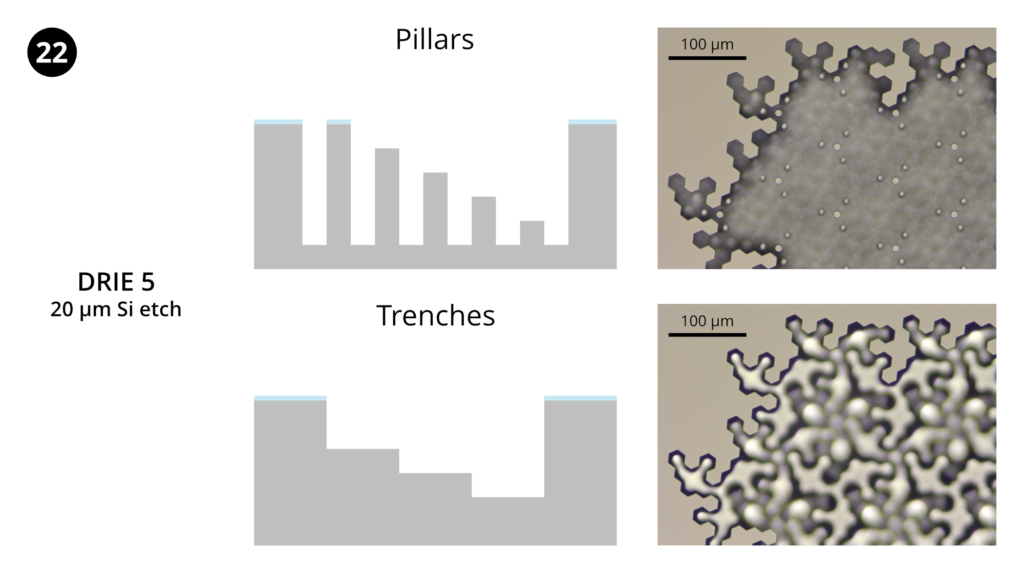
Step 22: Deep Si etch 5

Step 22: Deep Si etch 5. Etch a final 20 µm into Si using the "Bosch smooth sidewalls" recipe. All five pillar heights and three trench depths have been fabricated.
Etch a final 20 µm into Si using the Bosch smooth sidewalls recipe. All five pillar heights and three trench depths have been fabricated.

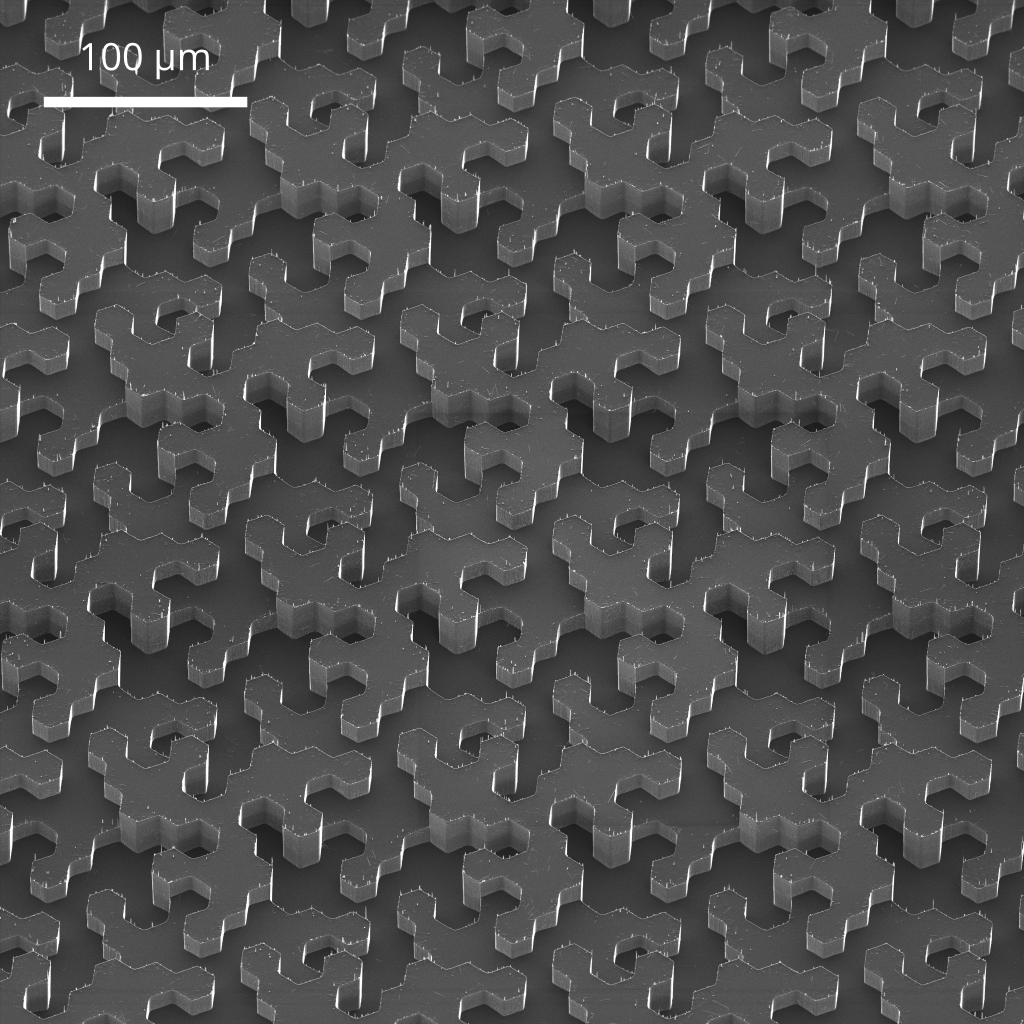
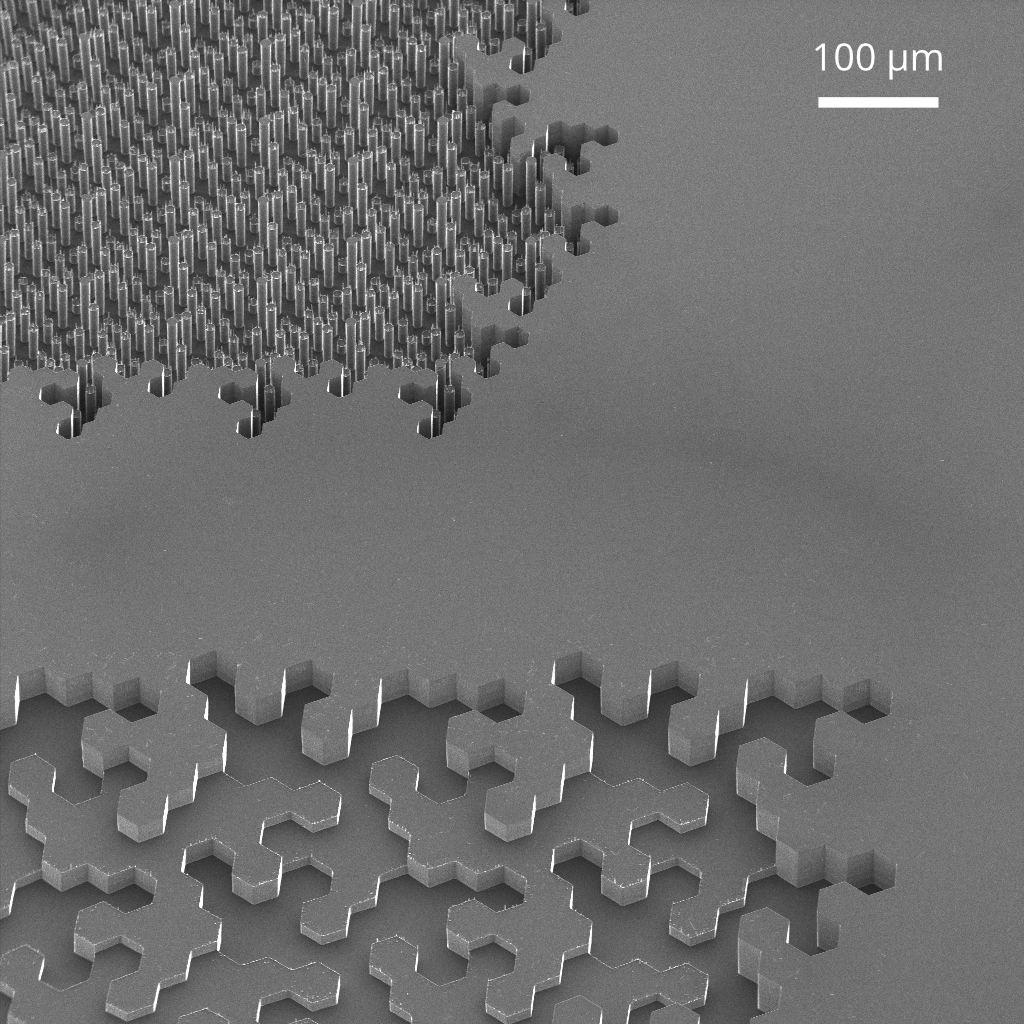
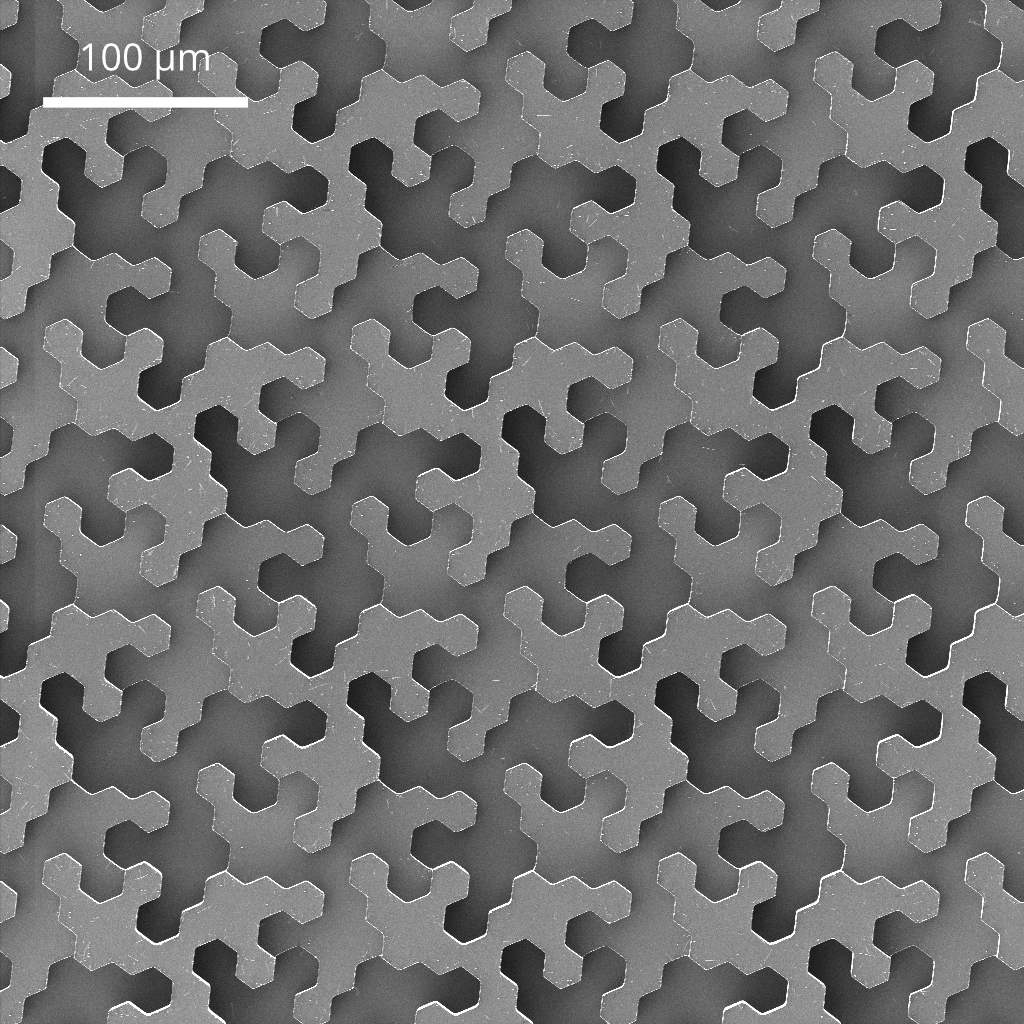
Imaging the final structures using He ion microscopy (HiM), both the pillars and trenches look as expected: adjacent features with heights differing by tens of µm are well formed, with vertical sidewalls and flat horizontal surfaces (pillar tops and trench bottoms). Note that many features are ringed with spikes of Bosch fluoropolymer residue—this specimen could benefit from further cleaning as described in our Bosch polymer removal comparison news post.

Pillars (40° tilt)
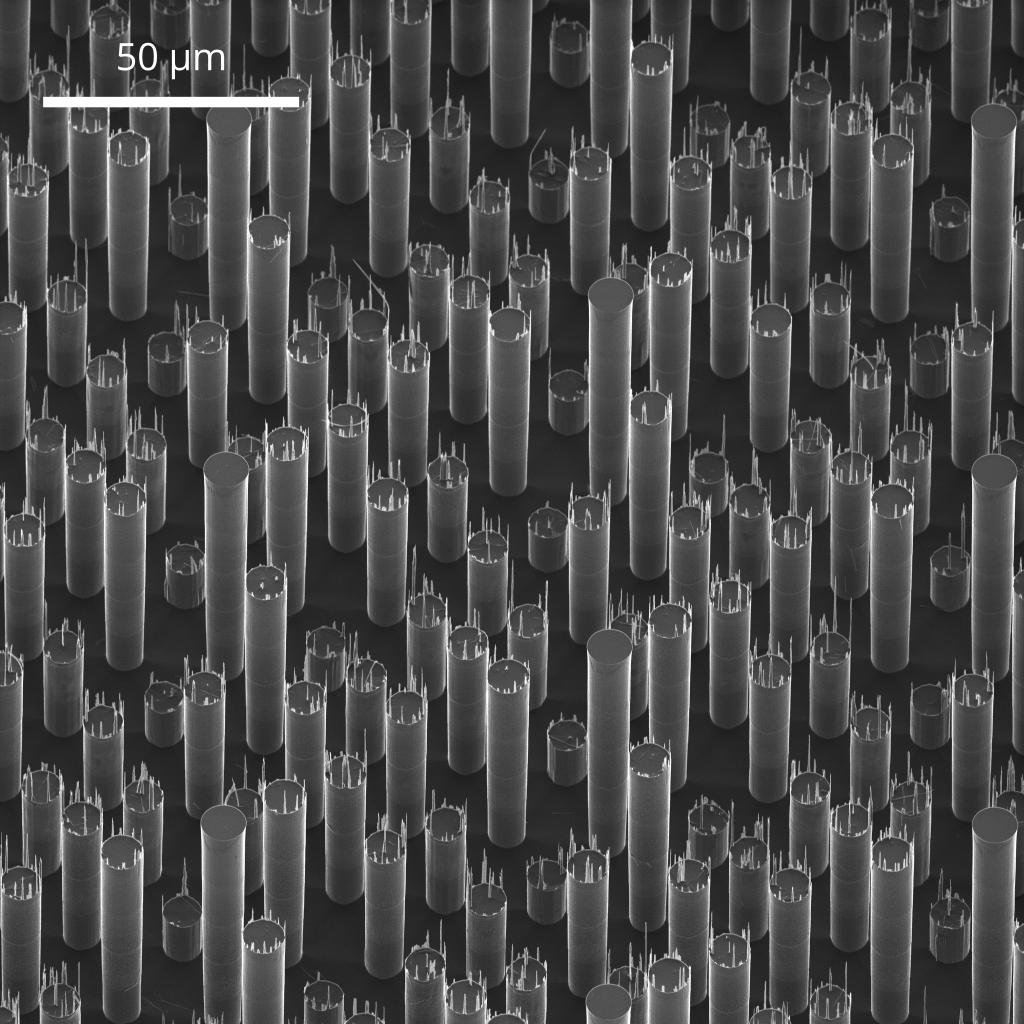
10 µm diameter pillars, 20 µm pitch, in hexagonal array. Nominal pillar heights are 20, 40, 60, 80, and 100 µm. Image acquired via HiM (40° tilt).
10 µm diameter pillars, 20 µm pitch, in hexagonal array. Nominal pillar heights are 20, 40, 60, 80, and 100 µm. Image acquired via HiM.

Trenches (40° tilt)

Tessellated trench structures with three depths; unit cells are composed of 19 hexagons with 20 µm flat-to-flat distance. Image acquired via HiM.

Pillars and trenches (40° tilt)

Border between 10 µm pillar region and 40 µm hexagon trench region. Image acquired via HiM (40° tilt).
Border between 10 µm pillar region and 40 µm hexagon trench region. Image acquired via HiM.

Trenches (0° tilt)

Top view of multilevel trench structure (20 µm hexagons). Image acquired via HiM.

Application examples

We have applied the above multilevel DRIE technique two recent fee-for-service fabrication projects in the microfluidics application space, both involving Si moulds for PDMS casting.
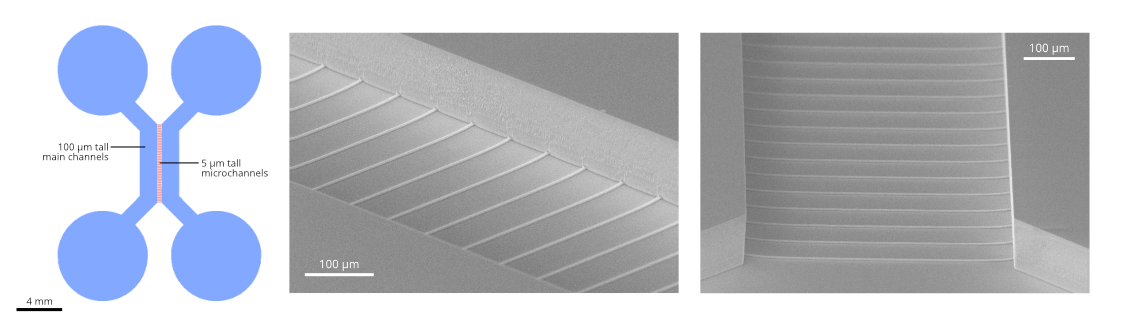
Microfluidic device layout (left), and SEM images (middle, right) of two-level Si mould. Two 100 µm tall main channels are connected at the bottom by 5 µm tall microchannels.

Microfluidic device layout (left), and SEM images (middle, right) of two-level Si mould. Two 100 µm tall main channels are connected at the bottom by 5 µm tall microchannels.

Courtesy of Shaun Sanders group (U Guelph).
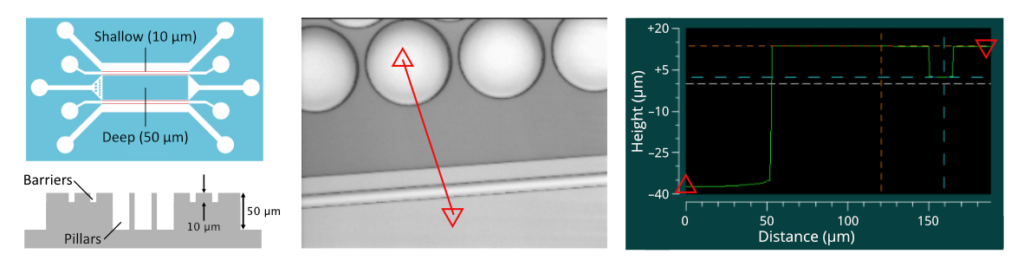
Microfluidic device layout and Si mould cross-section (left), and 3D optical profilometry scan (middle, right) of two-level Si mould. 10 µm deep barrier structures restrict flow into a 50 µm tall pillar array region.

Microfluidic device layout and Si mould cross-section (left), and 3D optical profilometry scan (middle, right) of two-level Si mould. 10 µm deep barrier structures restrict flow into a 50 µm tall pillar array region.

Courtesy of Anne Benneker group (U Calgary)

For more information about using this technique in your own fabrication work, or for fee-for-service fabrication enquiries, please contact Aaron Hryciw (ahryciw@ualberta.ca).