In-situ heating S/TEM is available

The nanoFAB is pleased to announce that the DENS solutions In-Situ Lightning TEM holder is fully commissioned and in-situ heating TEM analysis is available on the JEOL JEM-ARM200CF S/TEM Microscope.

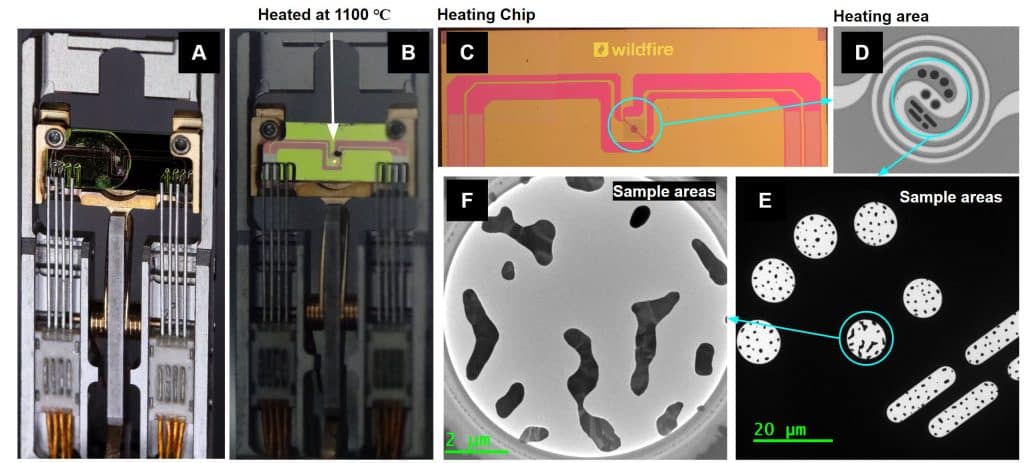
The DENS lightning in-situ heating platform utilizes the state-of-the-art MEMS technology to create the lab-on-chip environment that replicates the real-life heating conditions inside the TEM, which provides unprecedented control and accuracy over temperature:

All these unique features enable dynamic analysis of morphological (imaging), structural (diffraction) and compositional (EDX) changes of materials at very high spatial resolution on the JEOL ARM S/TEM.

The in-situ heating TEM analysis is now available to all users. If you have needs for these analysis, please submit a sample analysis request with sample details on LMACS. If you have any questions, please feel free to contact Dr. Xuehai Tan (xtan@ualberta.ca) – the primary TEM staff member or Peng Li (Peng.Li@ualberta.ca) – the Characterization Group Manager.

Images show (A) double tilted Dens Lightning holder, (B) heating chip being heated at 1100°C, (C) (D) heating chip and (E) (F) sample areas on the chip.

Application Examples

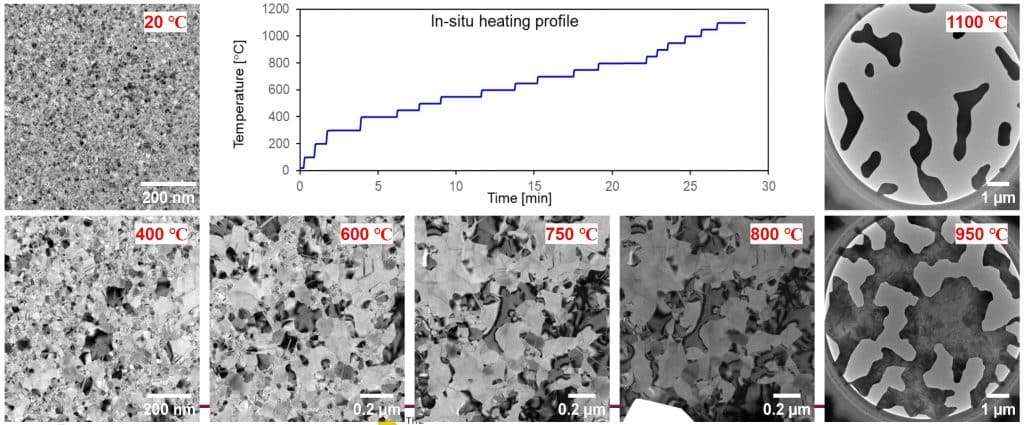
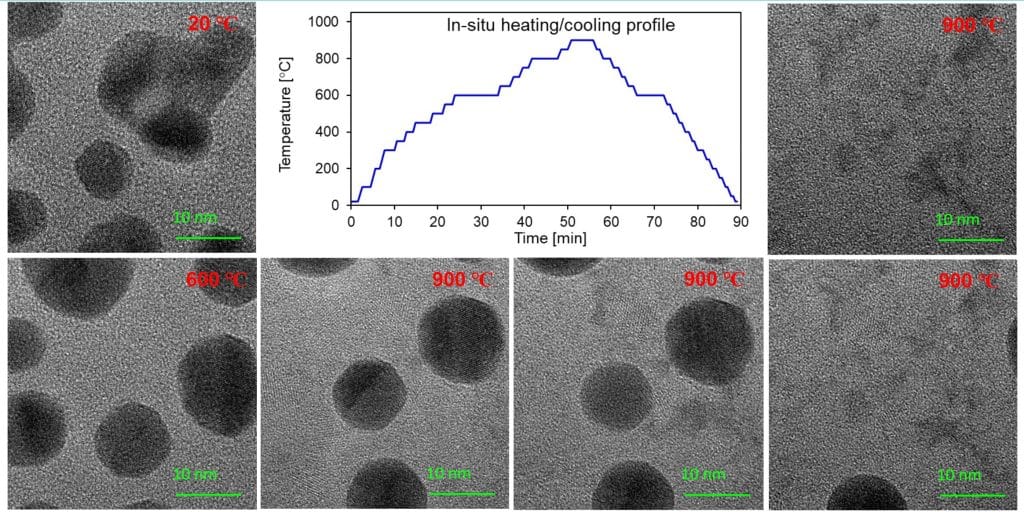
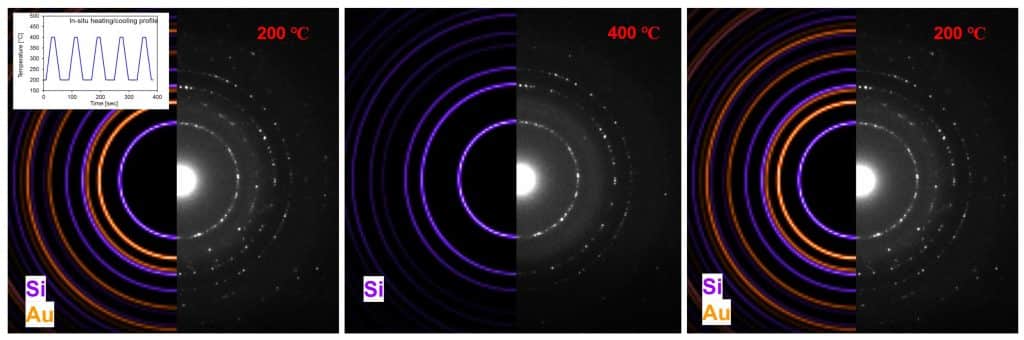
Recrystallization and melting of polycrystalline Au film heated up to 1100 °C
Morphological analysis by DF-STEM images: formation of particles up to 800 °C
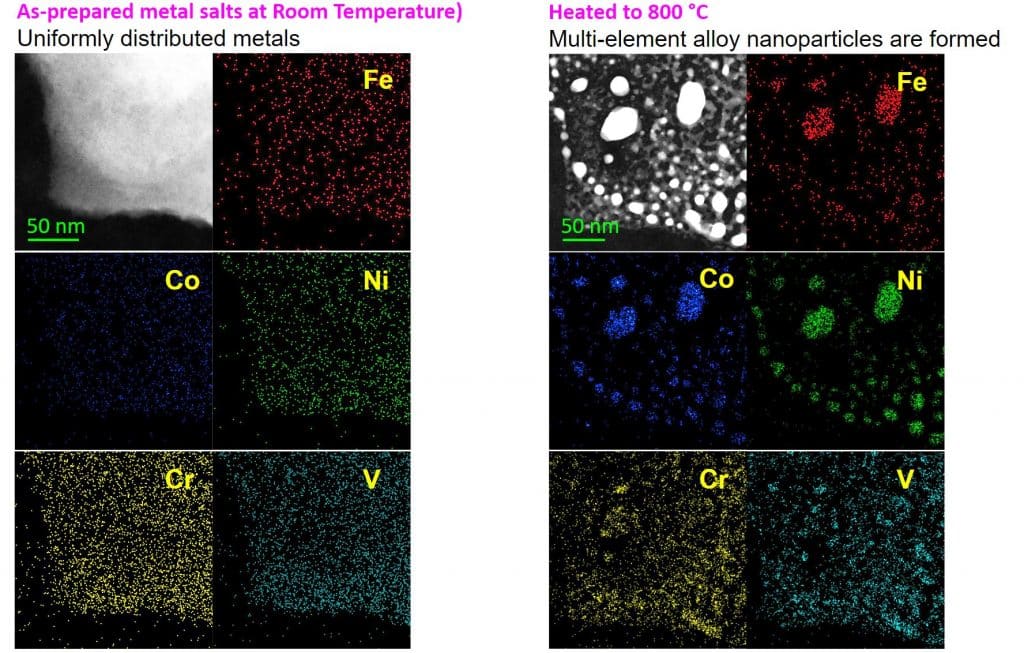
Compositional analysis by EDX: confirming the composition of the particles. Despite the influence of infrared radiation emitted from the heating device, EDS elemental mapping is acquired at elevated temperature (800 °C) during the in-situ heating.

Bruker D8D plus XRD-SAXS is Operational

The nanoFAB is pleased to announce that the new Bruker D8 DISCOVER Plus X-Ray Diffractometer has been successfully installed and is operational now.

The Bruker D8 DISCOVER Plus is a powerful and versatile X-ray diffractometer. It is designed for the structural characterization of the full range of materials from powders, amorphous and polycrystalline materials to epitaxial multi-layered thin films at ambient and non-ambient conditions.

The system features:

All the above features enable new characterization capabilities that were not available before at nanoFAB:

While our team is in the final commissioning phase of the system before we can open the system for general user work, trial analysis at no cost to users is available now. If you have needs for the advanced XRD/SAXS/GI-SAXS/WAXS analysis mentioned above and are interested in getting some preliminary results, please submit a “sample” request with sample details on LMACS. Our XRD team (Drs. Xuehai Tan and Nas Yousefi) will follow up and arrange test analysis. If you have any questions, please feel free to contact Peng Li (Peng.Li@ualberta.ca) – the Characterization Group Manager.

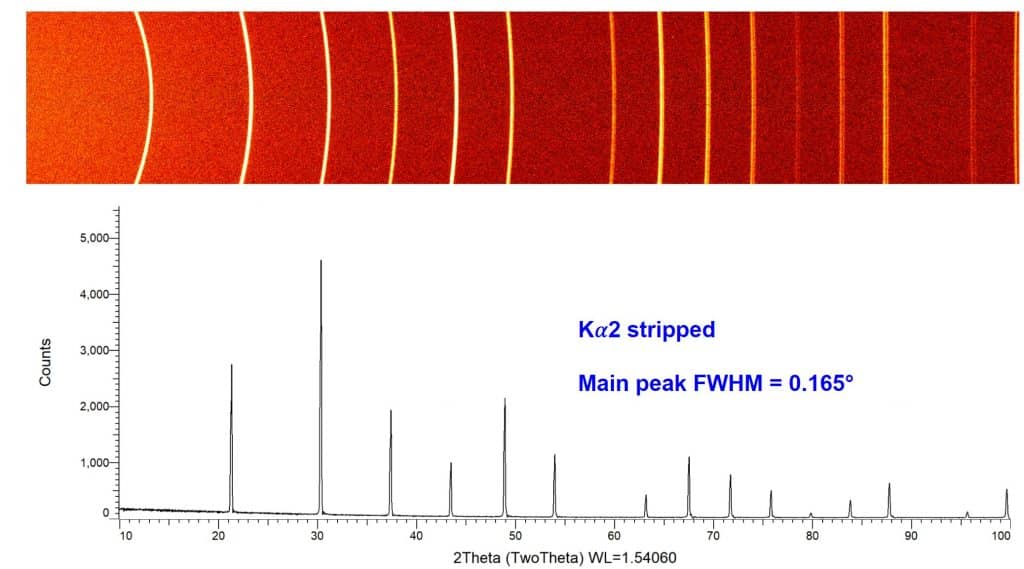
2D Powder Diffraction
Sample: LaB6 powder
Techniques: 2D scans with low instrumental broadening and excellent signal to noise ratio
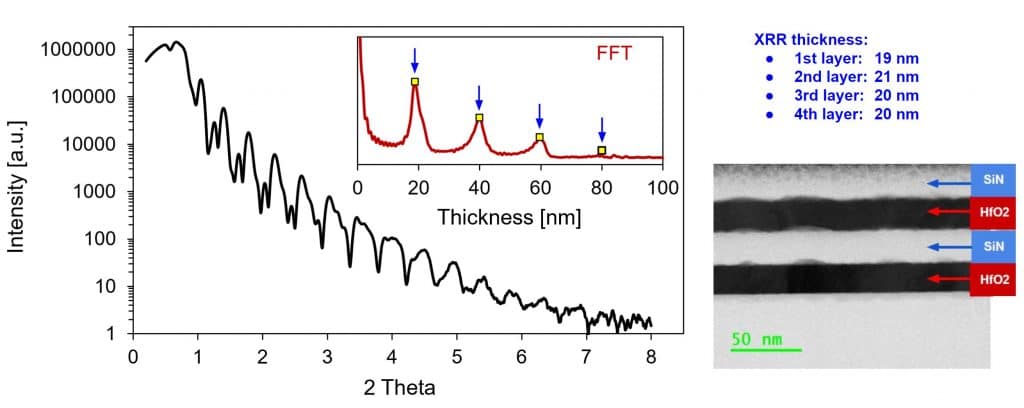
X-Ray Reflectometry
Sample: SiN/HfO2/SiN/HfO2 ALD film stacks on Silicon substrate (each layer thickness = 20 nm)
Techniques: XRR determining film thickness nondestructively. The results match the measurement by cross-sectional FIB/TEM analysis very well.
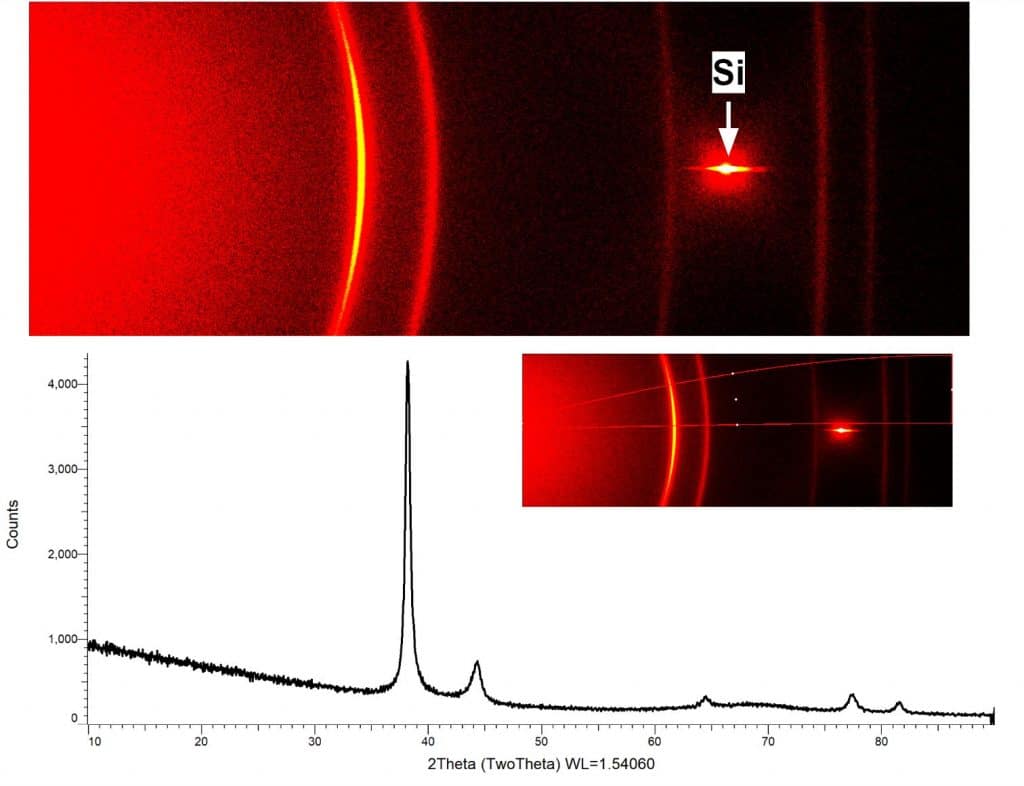
2D Thin Film Diffraction
Sample: 100 nm Ag film on Si substrate
Techniques: 2D scans with excellent signal to noise ratio, allowing intensity integration to eliminate the peak from Si substrate
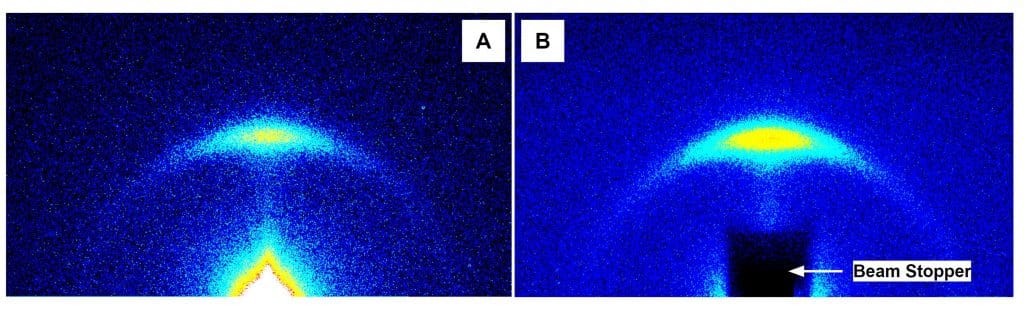
GI-SAXS
Sample: Organic Photovoltaic (OPV) film
Techniques: GI-SAXS with microfocus source provides flexibility of (A) measuring low q values without a beam stopper and (B) fast/high-throughput measurement of high q with a central beam stopper

Auto Slice & View (ASV) fully commissioned

The nanoFAB is pleased to announce that the FIB/SEM tomography is fully commissioned on the Helios Hydra Plasma FIB/SEM dual beam system

FIB/SEM tomography is a high-resolution 3D volume analysis technique, by serial sectioning – sequential application of SEM imaging and FIB milling.

Rocking mill minimizes curtaining effect

3D reconstruction of Mitochondria in Hela cells
Sample Courtesy: Drs. Thomas Simmen, Mike Hendzel and Xuejun Sun, Faculty of Medicine and Dentistry, University of Alberta
Process details:
Volume 1: O beam, 30 kV, 1.7 nA, 3 nm slice thickness, 4550 slices
Volume 2: Xe beam, 30 kV, 4 nA, 5 nm slice thickness, 5990 slices

Multiple ion species (Xe, Ar, O, or N) are available, enabling optimal ion beams for various types of materials. While Xe beam is suitable for general inorganic materials, Oxygen ions provide much better milling quality for biological samples embedded in resins, in terms of less milling artifacts.

The ASV FIB/SEM tomography process is now available to users as staff analysis. If you have needs for these analysis, please submit a “sample” request with sample details on LMACS. If you have any questions, please feel free to contact Peng Li (Peng.Li@ualberta.ca) – the Characterization Group Manager.

Porosity analysis of Porous Sn
Sample Courtesy: Drs. Peter Kalisvaart, Jillian Buriak (University of Alberta) and Bing Cao (Nanode Battery Technologies)
Process details: Xe beam, 30 kV, 4nA, 10 nm slice thickness, 895 slices

3D reconstruction of Al and Ce phases in Al-Ce alloy spheres
Sample Courtesy: Drs. Jonas Valloton and Hani Henein, Faculty of Engineering, University of Alberta
Process details:
Volume 1: Low Mag./large volume, Xe beam, 30 kV, 4 nA, 30 nm slice thickness, 2179 slices
Volume 2: High Mag./small volume, Xe beam, 30 kV, 4 nA, 5nm slice thickness, 1220 slices

New nanoFAB Characterization Staff

The nanoFAB is pleased to announce a new Applications/Research Specialist staff member – Dr. Nastaran (Nas) Yousefi in our Characterization group.

Nas is a physical/materials chemist with extensive research background in organic optoelectronic materials. During her PhD, she gained considerable experience with fabrication processes for organic electronics (e.g., transistors, biosensors), materials characterization (e.g., AFM, HIM, GIXAS), and electrical characterization techniques. Given the multidisciplinary nature of her research projects in the past, she has acquired a unique skillset that complements the expertise and capabilities at nanoFab.

Nas’ primary areas of responsibility are XRM, XRD/SAXS, BET, spectroscopy and electrical characterization/test tools. She will be working to support user training, fee-for-service work and process development. She is beyond excited to help researchers navigate through their path of discoveries and train students to become independent researchers.

Please join us in welcoming Nas!

Dr. Nas Yousefi in the Zeiss Xradia Versa 620 X-Ray Microscopy Lab


XPS analysis of air-sensitive materials

The nanoFAB is pleased to announce that analysis of air-sensitive materials is available on the PHI VP3 XPS system.

Proper sample handling is critical to analyze materials that are sensitive to air. We have been working to bring the capabilities of analyzing air-sensitive materials on to our analytical instruments. A controlled-environment transfer vessel is now commissioned and available to transfer samples from glove boxes to the PHI VP3 Versa Probe III XPS to minimize environmental exposure during sample transfer/loading.

Comparison of XPS results of a Germanium cluster material that consists of Ge atoms and silyl ligands between (1) using the transfer vessel and (2) short exposure to air, demonstrates the samples are well preserved by the transfer vessel to avoid oxidation. Sample courtesy: Christoph Wallach, Jonathan Veinot, Department of Chemistry, University of Alberta

Two graphs showing Ge 3d peaks: left graph in blue frame with transfer vessel, right graph in red frame exposed to air for 30 sec. Peaks represent Ge-Ge, Ge-O, and Ge-O2 interactions.

Prof. Lingzi Sang group at the Department of Chemistry, University of Alberta, has successfully characterized Na3SbS4/Anode Interface in All-Solid-State Sodium Battery, by utilizing the setup. For more details, please check their recent publication in ACS Appl. Mater. Interfaces 2022, 14, 48705−48714.

The process is now open to general users. If you are interested in XPS analysis of air-sensitive materials, please submit a sample analysis request on LMACS. If you have any questions, please feel free to contact Peng Li (Peng.Li@ualberta.ca) – the Characterization Group Manager.

Spin Mill with Plasma FIB

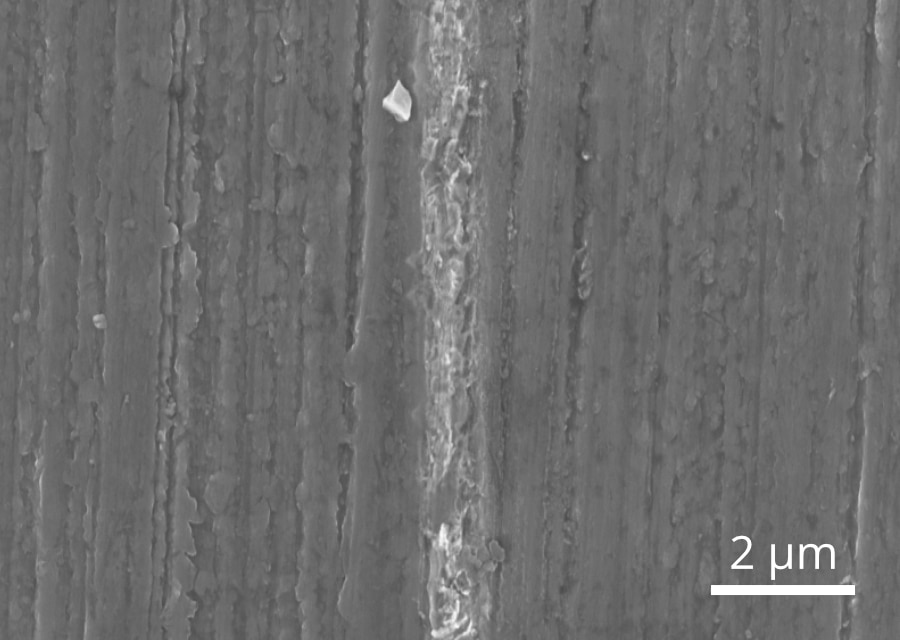
A new approach – Spin Mill, for large-area planar milling with ion beams is now available on the Thermo Fisher Helios Hydra Plasma FIB/SEM for accessing and investigating large areas (up to 1 mm).

The Spin Mill method offers alternative planar sample preparation, expanding the PFIB-SEM application beyond the conventional cross-section technique and Broad Ion Beam (BIB) milling. In combination with the flexibility of multi-ion milling, Spin Mill provides site-specific large area processes for various types of materials, which enables new characterization capabilities previously considered challenging.

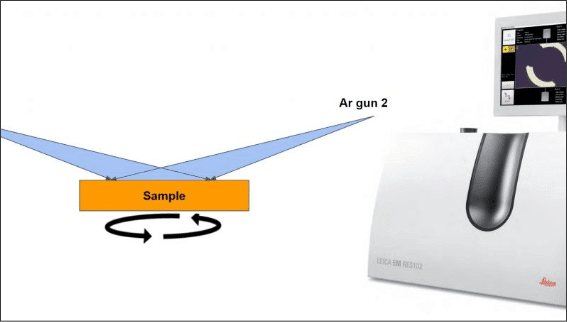
Spin Mill setup in Hydra PFIB

In the Spin Mill setup, the sample is mounted horizontally on the stage. The stage is tilted negatively, so that the PFIB beam mills the sample surface at a nearly glancing angle (typically between 1 and 5 degrees). The stage is periodically rotated through a full rotation of 360 degrees, which results in uniform planar polishing.

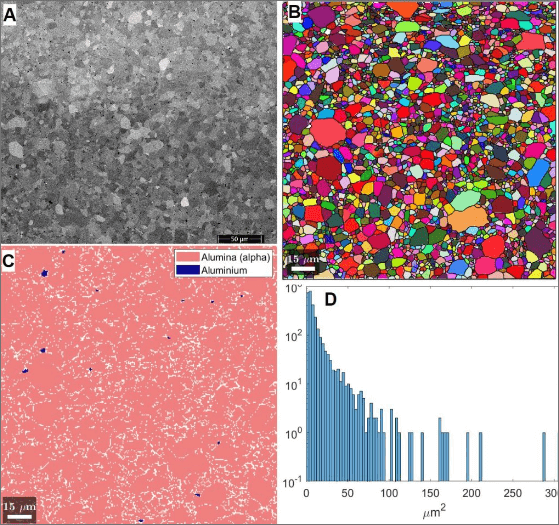
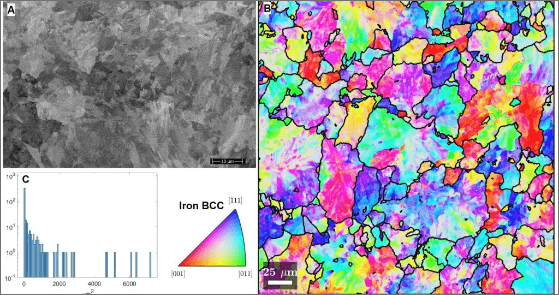
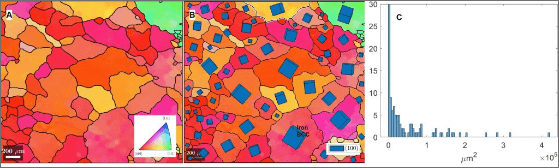
EBSD applications

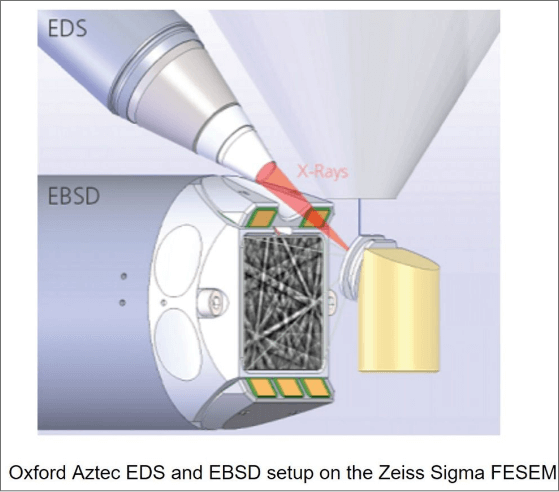
While the Spin Mill application offers new capabilities in a wide range of materials characterization, several groups have benefited from it for their EBSD analysis.

If you need to process your samples by ion beam spin mill, please submit a “sample” request with sample details on LMACS. If you have any questions, please feel free to contact Peng Li (Peng.Li@ualberta.ca) – the Characterization Group Manager.